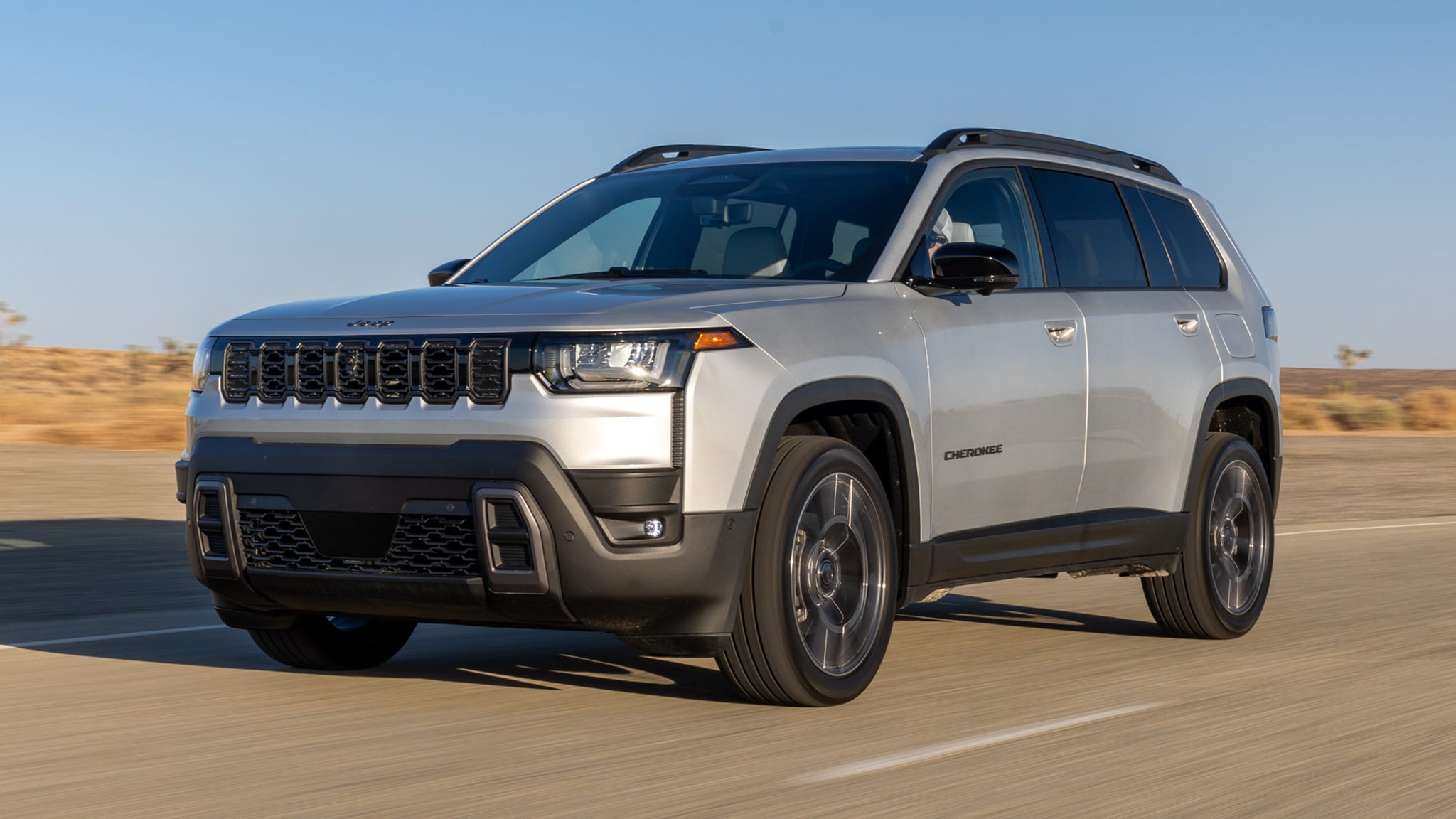
Built on the automaker’s new and flexible STLA Large vehicle architecture, the SUV offers all-wheel drive, hybridization, and general ruggedness. Of course, these features are also what the majority of buyers have come to expect from compact SUVs and thus are already found in myriad other vehicles in the hotly contested segment.

So what does that leave the Cherokee to offer? Standout driving dynamics? Maybe. The fact that it’s a Jeep? That’s more likely.
Powerful Name, Elegant Interior
Jeep is arguably the most valuable brand in Stellantis’ North American portfolio. The Jeep name alone, which predates when you think it originated, is today nearly eponymous with off-road capability. Steeped in history and heritage, these are clearly the driving forces behind the new Cherokee’s exterior styling. Though it lacks much outright design innovation, it’s still unmistakably a Jeep.
Even though the preproduction vehicle we tested wasn’t finalized in some respects, inside, there’s a lot to love. This Cherokee is bigger than ever, and it seems much of that has been translated into usable interior space. Given how roomy it is now, a couple of us wondered if some buyers might question their need for a Grand Cherokee. And the cabin itself looks very upscale and modern. We like the various textures and shapes, especially the Art Deco perforation patterns cut into the seat leathers. There is plenty of easy-to-reach storage for various loose items, too, which will be handy on the daily commute. The geometric steering wheel feels a bit strange in the hand but will no doubt be something owners will get used to.
The dual-screen setup is elegantly laid out: low in the driver’s sightline, with the driver’s screen and main infotainment screen distinctly separated from each other. The main digital display is bright, but certain MotorTrend editors found the graphic text to be quite small and the picture not very sharp. Furthermore, when we changed views on the screen, the animations responded with a slow frame rate. Hopefully this is sorted by the time these reach customers’ driveways. A few of the car’s climate functions, located on the left side of the screen, were completely blocked from view by the steering wheel, indicating a need for some UX improvements.

The rear seat receive mixed reviews. Some editors praised its spaciousness, although a few said it needs more thigh support. (It would be best for potential buyers to see how it fits them.) Either way, rear-seat passengers can take advantage of heated seats, climate vents, USB ports, and a power outlet. The Cherokee’s back doors also open wide, but not quite 90 degrees.
A generous cargo area can swallow up at least two full-size suitcases with additional room left over. There’s also a giant space under the rear floor for even more storage.

The Little Engine That Could(n’t)
All 2026 Cherokees come standard as hybrids (for now, anyway), so that means a 1.6-liter turbocharged engine working with a permanent-magnet motor to produce a total system output of 210 hp and 230 lb-ft of torque. Fuel economy rings in at an EPA-rated 42/33/37 mpg city/highway/combined, which is quite good for a vehicle of this type.
Sounds fine, right? But behind the wheel, the Cherokee is a bit of an enigma.
There’s a turbo and an electric motor, but neither provides the sort of punch you’d expect. The quickest 0–60 time we achieved was 9.4 seconds, but after a few other runs, we were clocking times deep in the 10-second range. We assume that’s because the battery was depleted, but there’s no battery level indicator anywhere so we couldn’t confirm our suspicions. Linear power delivery down low around town and in Sport mode make the Cherokee feel quick from a stop. But at higher speeds, plan your passes: The engine fights hard to keep accelerating, and it feels overburdened. By the time you reach 80 mph—roughly the speed the Cherokee is traveling after its long 17.1-second quarter mile—you’re looking forward to dipping back down to more comfortable cruising speeds.