Pros
- Strong engine, good handling
- Quiet ride
- Style all its own
Cons
- Slow-shifting transmission
- Weird brake pedal
- Average fuel economy
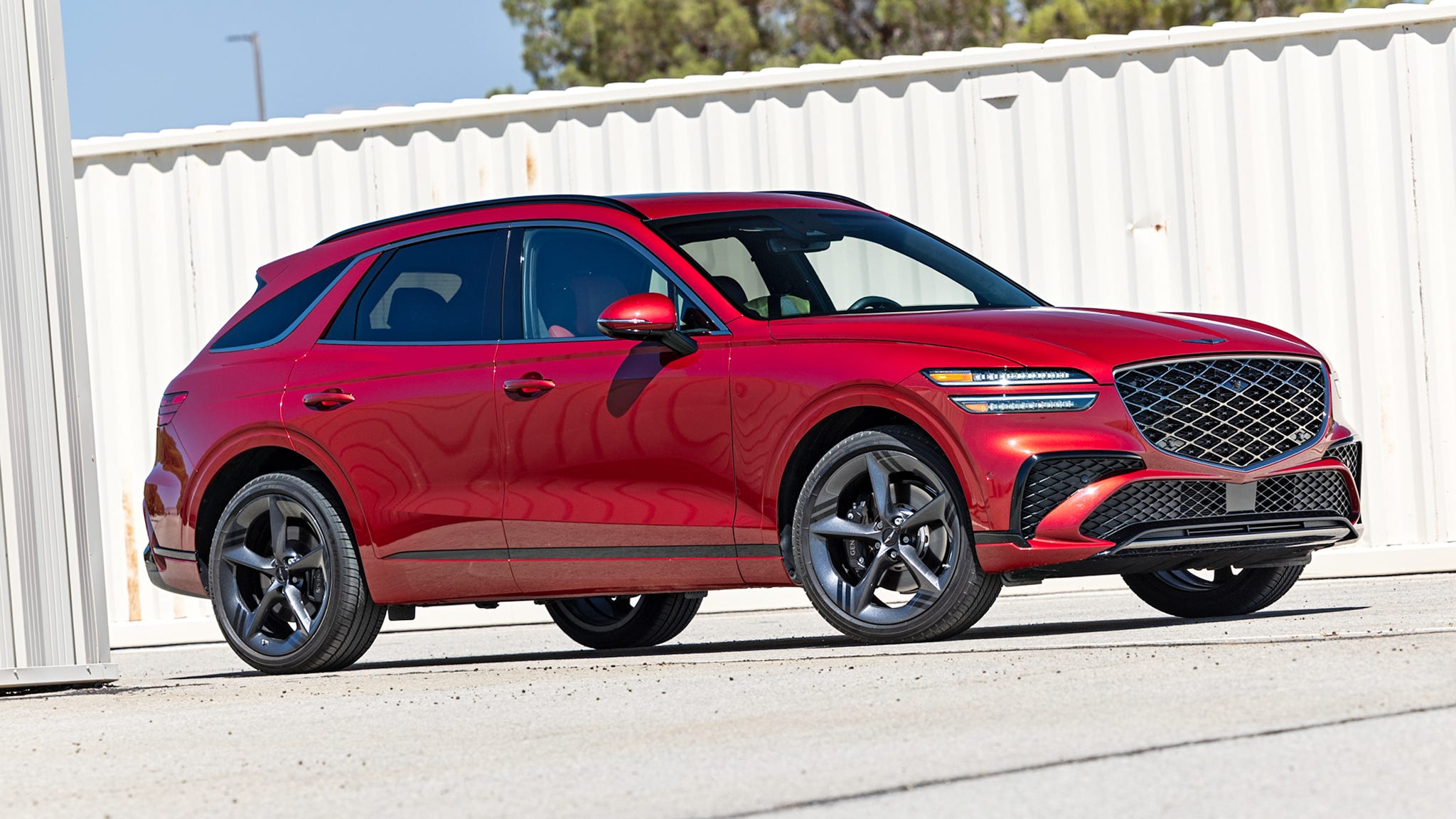
The Genesis GV70 hasn’t lost much of its luster since its stunning debut just a few years ago—a vehicle so impressive at the time that we crowned it our 2022 SUV of the Year. We were blown away by how it blended sharp handling and punchy powertrains with a uniquely crafted interior. Today, the GV70 remains the brand’s top-ranked luxury compact SUV, delivering the same mix of driving fun, upscale design, and everyday usability that made it a revelation in a crowded segment.
But the competition has been busy. Rivals from BMW, Mercedes-Benz, and Cadillac have all seen major updates recently. To counter those moves, Genesis has rolled out a new round of tech and styling updates for the 2026 GV70 lineup, including a sweeping new digital dash and infotainment display, improved voice recognition, new ambient lighting, and more expansive over-the-air updates, among others.
To get a better sense of those enhancements, we sampled a top trim 2026 GV70 Sport Prestige equipped with the uplevel 3.5-liter twin-turbo V-6 generating the same 375 horsepower as before, which offers a healthy power advantage over the base turbo-four. Apart from the addition of the brand’s so-called Highway Body Motion Control suspension tuning, not much has changed from a performance perspective, though during our testing we found that the updated GV70 still makes a strong case for itself overall. How strong?

Familiar Driving Experience
Bury the throttle from a stop, and the GV70 Sport Prestige still rewards with a lively kick, though not without a hint of turbo lag—unless you’ve dialed up Sport or Sport Plus, disabled the nannies, and engaged its launch control feature. Midway through the revs, the engine note sharpens into a snarl that only grows; it’s the kind of soundtrack enthusiasts will savor.
Output isn’t overwhelming, but it’s more than enough for everyday driving, with power delivered in a smooth, linear fashion. The eight-speed automatic holds gears aggressively when pushed, though it can take a beat to figure out when you want to go fast. Testing shows the 2026 model is slightly quicker than before, shaving two-tenths off the 0–60 sprint of the last 3.5-liter powered model we evaluated.
Straight-line performance remains solid, but rivals like the BMW X3 M50, with its brawnier six-cylinder mild hybrid, make far more torque than the GV70, and it accelerates to 60 in just 4.0 seconds—over a second quicker than the 5.2-second time of the Genesis. For sheer muscle, the BMW has the edge.
But the GV70 has a counterpunch: the curves. Out on a winding road, it feels planted and composed, thanks in part to its weighty, precise steering action and electronically controlled suspension with a road preview feature. New for 2026 is the aforementioned Highway Body Motion Control, a damping system manager that emphasizes ride comfort without resorting to the stiffness often associated with sportier SUVs. It works by using a front camera, sensors, and navigation data to anticipate road imperfections and adjust damping in real time to smooth bumps and control body motion. The suspension did seem on the softer side during typical on-road driving, possibly the hand of this new feature at work.

As for the brakes, while a bit odd in modulation (they can get grabby midway through the pedal stroke), they deliver more than acceptable stopping power, at 124 feet from 60 mph to a stop. Although predictably its overall dynamic performance numbers don’t show any gains over the last GV70 we tested, and it’s bested by the sharper, more powerful, and summer-tire-equipped X3 M50, there’s still plenty of fun to be had behind the wheel of the GV70—especially when the road starts to bend.
Efficiency Isn’t Its Strong Suit
If fuel savings are top of mind for you, the GV70 probably isn’t your best bet. The twin-turbo V-6 and AWD powertrain combo manages just 18/25 mpg city/highway according to the EPA, while the four-cylinder does only marginally better (20/26-28 mpg).
Making matters worse, the BMW X3 M50 xDrive manages more than respectable efficiency for its class, returning a far better 25/30 mpg city/highway. A hybrid GV70 could help close the gap, but that option doesn’t exist—at least not yet. (There is an all-electric version of the GV70, however.) Until then, heavy-footed owners should get used to making frequent fuel stops.

Value and Luxury Still on the Menu?
The GV70’s cabin continues to impress, thanks to its bold design, premium materials, and a deep roster of tech. The new 27.0-inch dash display acts as the interior’s new headline feature, though it falls short of the Cadillac XT4’s 33-inch screen and lacks the dramatic curve you’ll find in the BMW X3 and XT4. The touchscreen part of the wide display functions mostly like the outgoing 14.5-inch model, and we’re fans of the new center console, particularly how the climate control screen moves from the center stack down to the console.
Quality remains a strong suit. Our Sport Prestige test vehicle featured standard quilted Nappa leather, distinctive carbon-fiber trim, ventilated and massaging “Ergo Motion” front seats, and a highly adjustable driver’s chair. Other highlights included a head-up display, three-zone climate control, heated second-row seats, rear sunshades, 21-inch wheels, and remote smart parking assist.
That said, the GV70 no longer feels like the bargain it was at launch. Upper trims now command some of the highest prices in the segment—unexpected from a brand still carving out space in the luxury arena. Recent improvements across the lineup, including upgrades like wireless phone mirroring and the larger display with every trim, bolster the entry-level models, but they don’t do much to justify the cost of fully loaded versions.