Pros
- U.S. model’s more usable top speed
- Decent at turning and stopping
- Smooth, quiet acceleration—what little there is
Cons
- Lower payload than diesel model
- Archaic fast-charging speeds
- Limited range limits its use
Our first exposure to Mercedes-Benz’s electric eSprinter van, at an early drive in Stuttgart, left us mildly traumatized. Mercedes invited MotorTrend to drive the eSprinter on a no-speed-limit section of the autobahn, the punch line being that the German version of the van is electronically limited to 99 kph (that’s 61.5 mph for those of you who prefer your numbers in units of freedom). Also, we were driving the 134-hp version of the eSprinter, as opposed to the 201-hp version we will (eventually) write about in this story. Even so, we figured that with electricity powering the wheels, the eSprinter would still scoot like a scooty thing, as most EVs are wont to do.
Boy, were we wrong.
Playing Frogger on the Autobahn
Germany’s autobahns, despite the lore, are not the exclusive domain of low-flying Porsches, Audis, and Benzos tickling the sound barrier. Trucks drive on it, too, generally at a lumbering 80 kph, a speed known to us ’Muricans as 50 mph. Germans take the whole slower-traffic-keep-right thing like a religious mandate, God bless ’em, but for us in the glacial eSprinter, that meant trying to find a crack in a short but solid wall of semis before the merge lane dissolved into guardrail. In the diesel Sprinter, we could simply surge ahead or drop back for a gap and quickly match speeds. The eSprinter’s limited speed and acceleration, which called to mind a sloth with shin splints, limited our options.

We managed to find a Sprinter-sized space, by which time our knuckles were looking appreciably paler than the rest of our hands, and we seriously considered hanging with the trucks for the rest of our drive. However, journalistic integrity and ego dictated we drive the Sprinter as fast as possible. Also, the quicker we drove, the quicker we’d make it to lunch.
Getting past the slow trucks in the only slightly less slow eSprinter meant waiting for a big enough gap in the center lane; we figured one roughly the length of Iowa would suffice. We soon realized such a gap was unlikely to appear until the next ice age killed off all our fellow drivers. No choice, then: We floored the accelerator, plopped into the center lane, and waited an eternity for 100 kph, and then waited another couple of eternities to pass the convoy. Underpowered Volkswagens and Opels piled up behind us, flashing their lights in Europe’s two-digit version of the middle-finger salute. If you’ve ever played Frogger, you know exactly how we felt.
America Gets a Speed Bump
Those not so fond memories came flooding back when Mercedes offered us a U.S.-spec eSprinter to test. We were buoyed by the fact that the U.S.-bound version has its limiter turned up to a more useful 120 kph, which around here goes by the pen name 75 mph. We’d also be getting the 201-hp version of the van, as opposed to the 134-hp variant we drove in Germany. We haven’t been able to find any acceleration estimates for the lower-power van, no surprise since you can’t get a 0–100 kph time on a vehicle that only goes 99. Still, horsepower describes the rate of doing work, so while torque is the same for both versions—295 lb-ft—we figured merging in the higher-horsepower van might not be quite so harrowing.
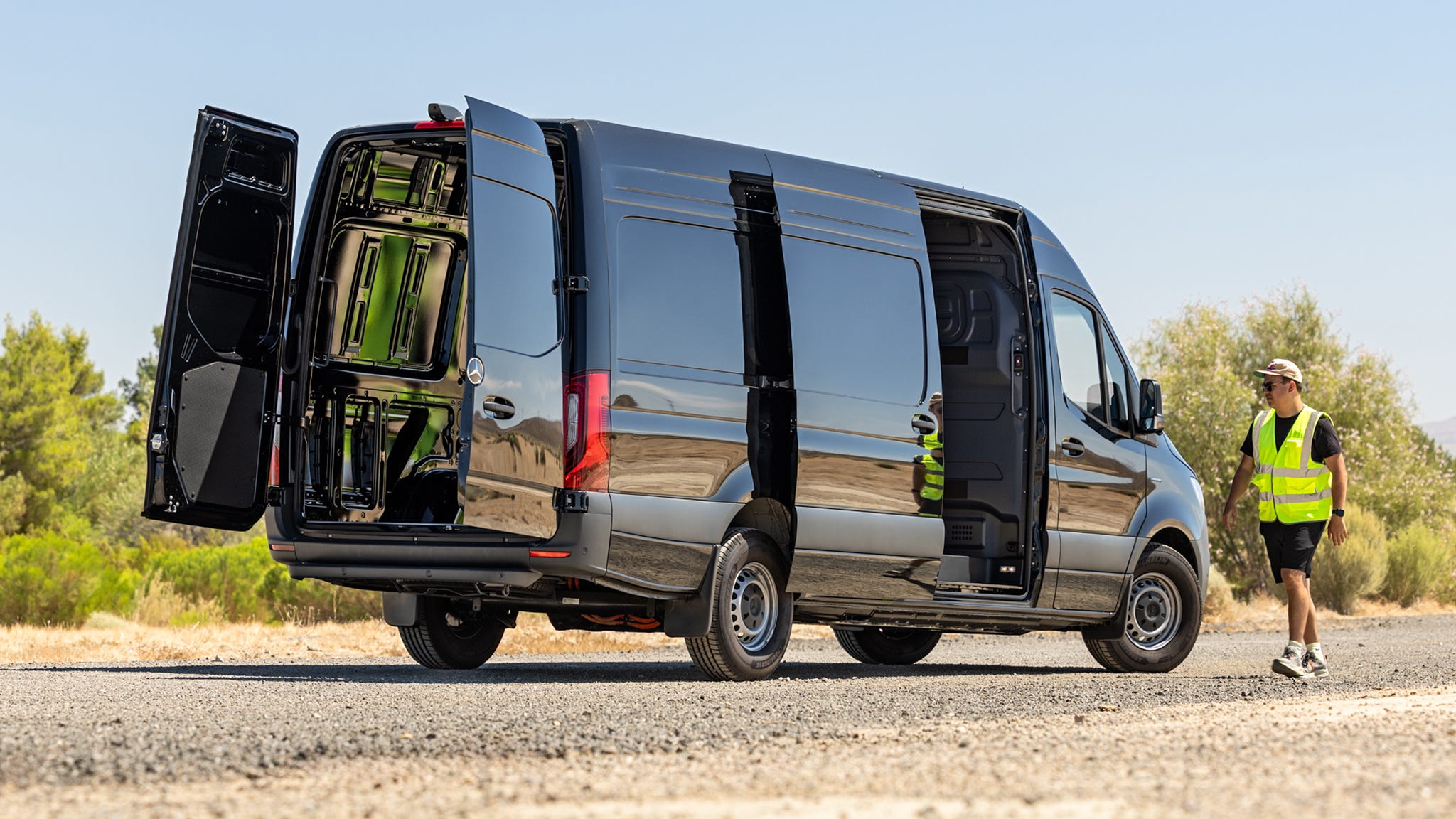
Still, we were a bit unnerved to learn that our test van was the high-roof, long-wheelbase, big-momma configuration, and it was fitted with the larger and heavier 113-kWh battery. Mercedes offers an 81-kWh battery that decreases EPA range from 206 to 150 miles but increases payload by about 500 pounds. Since the eSprinter is designed to be a local-delivery vehicle, Mercedes says, long range isn’t critical.

Off to the test track we went, curious to see how electric power compared to a diesel model. We hadn’t tested a diesel Sprinter in this configuration (we’re MotorTrend, not VanTrend), so the closest we could get for comparison purposes was our recently departed long-term diesel Sprinter, also a long-wheelbase, high-roof spec, but with its 208-hp diesel engine driving all four wheels. (All eSprinters come exclusively as rear-drivers.) We thought our long-termer was a porker at 6,062 pounds, but the eSprinter outweighed it by 910 pounds. Its single electric motor trailed the diesel by only 7 hp, and its 295 lb-ft of torque represented 37 fewer lb-ft of twist.
Wait, Aren’t EVs Supposed to Be Quicker?
Normally we do our acceleration in Sport mode, but the eSprinter has no such thing; there’s only Comfort, Eco, and Max Range. We figured Comfort was our best bet. Acceleration testing in the AWD diesel Sprinter (which we did on four separate occasions) was always a great time to catch up on our reading, and the eSprinter was no different, but with a more librarylike environment. It made it to 60 mph in 11.9 silent and smooth seconds, 0.2 second slower than our long-termer.
We figured the 75-mph speed limiter might be a problem in our quarter-mile testing. Nope—the eSprinter was only doing 73.4 when it crossed the finish line some 18.9 seconds after starting. In case you’re an eSprinter driver wondering if you should challenge the next diesel Mercedes van that comes along, our advice is not to try: Our AWD diesel took 18.3 seconds at an even 74 mph, and we imagine a rear-drive, betailpiped Sprinter would be slightly quicker. (By the way, if you’re a real Sprinter fanatic, you’ll be interested to know that a lighter-weight, short-wheelbase, low-roof 4×4 Sprinter we tested at TOTY 2025 made 60 in 10.4 and the quarter in 17.6. If you’re not a Sprinter fanatic, you probably fell asleep two paragraphs ago.)

Outcorner Hummer H1s and Dump Trucks
Braking? 138 feet from 60 mph, 6 feet shorter than our all-wheel-drive van, which is all tires. The eSprinter’s stop felt shorter than it was, thanks to good behavior from the van—arrow-straight stops with none of the shakes, wobbles, or swerves we expected from something so big and heavy. We can name many, many SUVs—and even a few cars—that feel less secure in panic stops.
Finally, it was time for our figure-eight handling test. We dreaded this one in our long-termer—it seemed like a great way to bring the side windows into a closer acquaintance with the pavement—until we figured out that the Sprinter’s sophisticated stability control system, which calculates the height of the center of gravity every time you drive it and adjusts itself accordingly, made for easy driving. We did the whole thing with the accelerator to the floor. Turning in would trigger stability control and drop the van’s speed to 30 mph, and the diesel could only pick up another 10 mph or so on the straightaway.
The eSprinter had the added advantage of that big battery set under the floor, as well as the entire electric drive mechanism. It leaned like crazy but never felt like it would tip, and, as with the diesel van, the stability system cut the power to keep the van, uh, stable. The strong brakes let us carry our speed deep into the corners, helping the eSprinter spank the diesel. It made the circuit in 31.2 seconds as opposed to the diesel’s 32.7. That time put the eSprinter right up there with such track-ace luminaries as the Ineos Grenadier and the previous-gen Jeep Wrangler Rubicon. Our long-term diesel Sprinter, meanwhile, was back in the dust with only the Hummer H1 Alpha and a Ford F650 dump truck for company.