Pros
- Looks badass
- Extremely comfortable off-road
- Muscular powertrain
Cons
- Breathy fart intake noise
- Trucky on-road behavior
- Cargo floor height
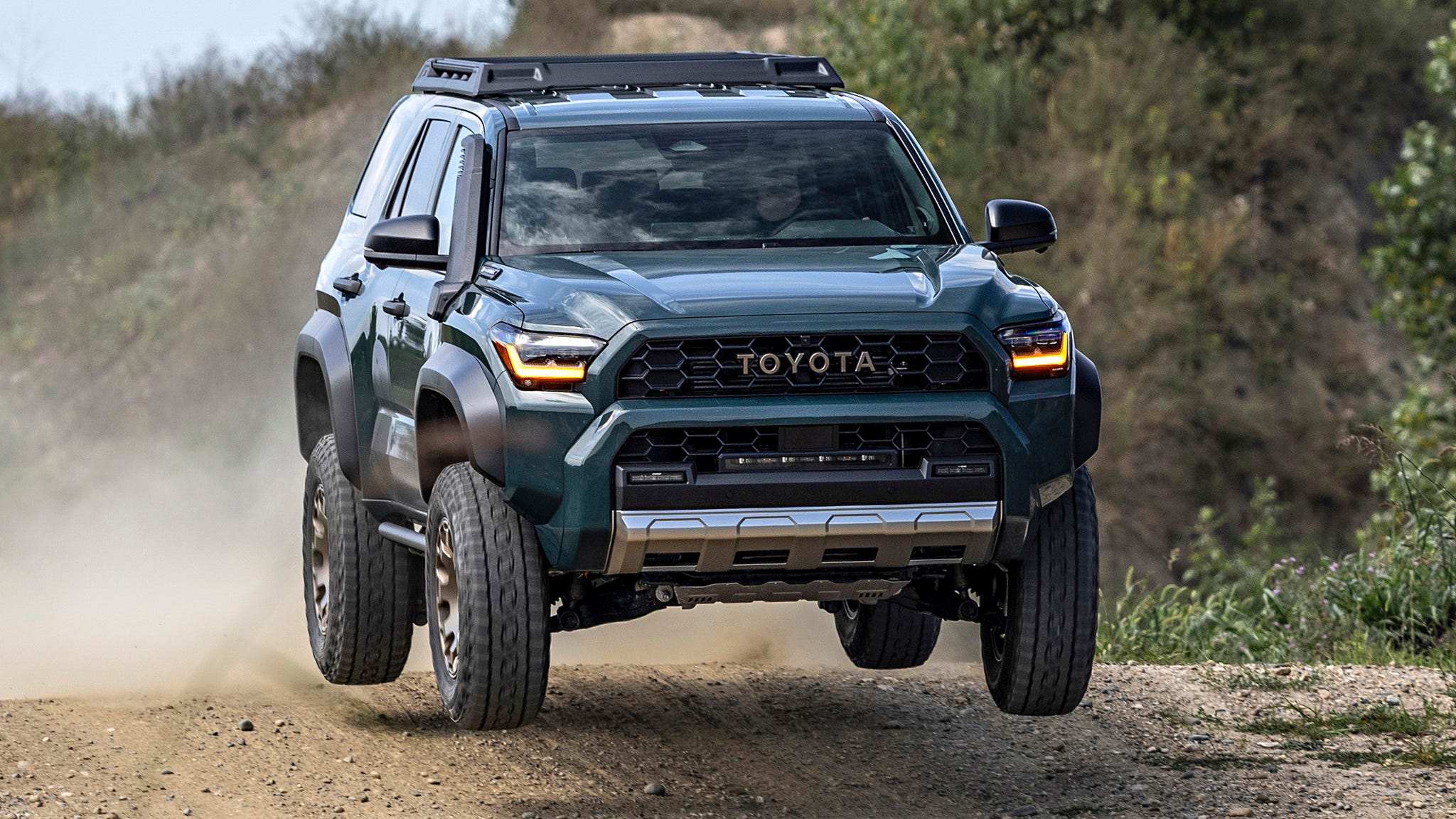
In the sixth-generation Toyota 4Runner lineup, the Trailhunter variant is peak 4Runner. It has the same widened stance, lifted suspension, and 33-inch tire size as the identically priced 4Runner TRD Pro, but let’s be real—even though the latest TRD Pro and its newfound desert-running capabilities are awesome, the new Trailhunter is the burliest 4Runner in the traditional sense. Mostly it’s because of the look, which includes a standard metal roof rack, exclusive bronze wheels, and a high-inlet air intake that climbs up the passenger-side windshield pillar.
With the new TRD Pro having pivoted to chasing Ford Raptors over jumps and dunes and stuff, the new-to-4Runner Trailhunter trim is geared toward lower-speed crawling and general off-road ride comfort—essentially copying and pasting over the old TRD Pro’s tuning philosophy. Of course, the last-generation 4Runner TRD Pro was capable as all get-out off-road—and this new Trailhunter’s even better—despite being borderline awful on road. So, has peak 4Runner progressed at all on-road?

What Is a Trailhunter, Anyhow?
From top to bottom, the new 4Runner family drives better than before. That’s a relatively low bar to clear, of course, but even festooned with all the toys, the Trailhunter is no different. It rides on a set of third-party-sourced Old Man Emu shocks—with remote reservoirs on the rears—and unique springs that lift it 1.5 inches in front and 2.0 inches in rear. There’s a front anti-roll bar disconnect system to enhance articulation, too, and those sweet bronze wheels are wrapped by 33-inch Toyo Open Country all-terrain tires. With a 3.2-inch(!)-wider track front and rear (same as the new TRD Pro), the Trailhunter’s wheels and tires stick out proud of the bodywork.
The Trailhunter is also almost comically heavy, with its standard hybrid powertrain (optional on lesser 4Runners), beefy ARB roof rack (with a 700-pound static capacity), and other add-ons ballooning its curb weight to 5,586 pounds. This is the heaviest new 4Runner you can buy—a curiosity in that its payload capacity (including people and stuff) is limited to 1,005 pounds, even though this is the model aimed squarely at gear-toting overlanders. It’s worth noting that lighter 4Runners can carry up to 1,550 pounds.
About that hybrid powertrain. The Trailhunter is powered by Toyota’s i-Force MAX setup combining the same 278-hp turbocharged four-cylinder engine used in i-Force (non-MAX) 4Runners with a 48-hp electric motor where the eight-speed automatic transmission’s torque converter would be to produce 323 hp and 465 lb-ft of torque.
Other MAX-powered 4Runners make 3 hp more, but they don’t have the Trailhunter’s peacocking intake snorkel snaking up their passenger-side A-pillars, do they? Step on the gas, and that power-sapping snorkel sounds like you stepped on someone’s midsection after a Taco Bell lunch, amplifying the turbo engine’s whooshing intake white noise to the point that it sounds like an rpm-sensitive wheezing fart. The soundtrack is annoying, although it’s less noticeable here than in the mechanically related Tacoma Trailhunter pickup with the same basic setup. But before you point the 4Runner’s snoot at deep water, keep in mind that the snorkel doesn’t raise the Trailhunter’s wading depth at all—the unsealed unit is simply there to gobble up cleaner air in dusty conditions.

How Does This Bruiser Go, Stop, and Turn?
The new 4Runner drives far better than you’d expect in Trailhunter guise, particularly if you’ve spent any quality time behind the wheel of the previous-generation TRD Pro model. As we noted in our first drive, give credit to the Trailhunter’s wider track, which seems to do a lot of work keeping the tall, heavy SUV’s handling feeling stable and controlled. While the body still pitches fore and aft when stopping or accelerating hard, and leans when initiating a turn, all those motions are far more reined in than in the old TRD Pro.
The Trailhunter’s 0.72 g of lateral grip might not seem like much—several Jeep Wranglers we’ve tested have done better—but the way it achieves that number is revelatory. Where the Jeep (perched on dual live axles) feels genuinely concerning when exploring its handling limits, the 4Runner Trailhunter (with only a live rear axle) is secure and almost ordinary in its moves. The tires clearly aren’t suited to skidpad evaluations, and the body roll is there, but the Toyota’s mass is evenly distributed front to rear, and the steering is fairly accurate.

Stopping is also decent, in spite of the tires. A 121-foot stop from 60 mph for something this heavy is pretty good, and although it’s accompanied by plenty of nosedive, hard braking events don’t send the 4Runner squirreling around. Our only complaint? That the brake pedal operates in a numb manner, with a distinct switchover between the regenerative and mechanical braking that’s difficult to modulate, leading to un-smooth stops around town.
Thanks to the MAX’s electric assist, this is the quickest current-generation 4Runner we’ve tested yet, reaching 60 mph in 7.4 seconds. But keep in mind it’s also the heaviest at nearly 5,600 pounds. We expect that lesser 4Runners with the same powertrain will be quicker.
Either way, the powertrain is way more modern than the 270-hp 4.0-liter V-6 of yesteryear. (Those 4Runners reliably sauntered to 60 mph in about 8.0 seconds.) The Trailhunter’s hybridization helps smooth over some of the new turbo four-cylinder’s paucity of low-end torque, but there remains detectable lag between mashing the gas and the i-Force MAX engine and motor spinning up to max steam. In everyday driving, however, the powertrain’s torque feels muscular, and the switch from a five-speed automatic to the eight-speed is transformative—no more random gear hunting when hitting slight grades on the freeway.