We were impressed when we first drove the 2026 Mercedes-Benz CLA. The electric subcompact sedan punches above its weight, riding on a new platform with 800-volt architecture and boasting a new operating system for its infotainment system. It all makes for overall impressive driving characteristics befitting the three-pointed star.
That was in Copenhagen. A recent trip to San Francisco and another stint behind the wheel of the model that hits dealerships this month confirmed it was not just Danish charm coloring our first impression. It is indeed a lovely car to drive, both the 268-horsepower CLA 250+ single-motor version and the more neck-snapping 349-hp 350 4Matic with dual motors. Still to come is a mild hybrid with a new 1.5-liter turbocharged four-cylinder engine and an electric AMG version.
While in San Francisco, we took a closer look at the third-generation CLA’s interior. This is where owners spend their time, of course, and most of the driving we all do isn’t a dynamic romp in today’s increasingly congested cities. In other words, the CLA is an entry-level Mercedes, so it needs to be nice enough inside to hook customers into becoming loyal to the brand for life. But Mercedes couldn’t spend too much money on it in its quest to keep the new CLA entry-level affordable.
After experimenting with a new look for the EQS and EQE all-electric vehicles that lacked the elegance Mercedes is known for, the automaker changed course here. All CLAs look the same, with longer and more traditional hoods and body lines, regardless of powertrain. Telegraphing the new age: the illuminated Mercedes star on the grille that is lit by a galaxy of 142 bright stars.

Good Quality Materials
Materials are indeed up to snuff, and there are a range of available colors, finishes, and materials including leather and a new upholstery in industrial black and white with a pearl effect. There is trim seen in all the usual luxury suspects: open-pore wood and aluminum, but also a unique natural-fiber finish made from paper.
Familiar big round air vents bookmark the dash, with a long rectangular vent in the center. The front seats are heated with lumbar support and massage functionality, depending on the trim level. Some have kinetic movement designed to keep the circulation moving in your back and bottom. A Dolby Atmos sound system tickles your ears.
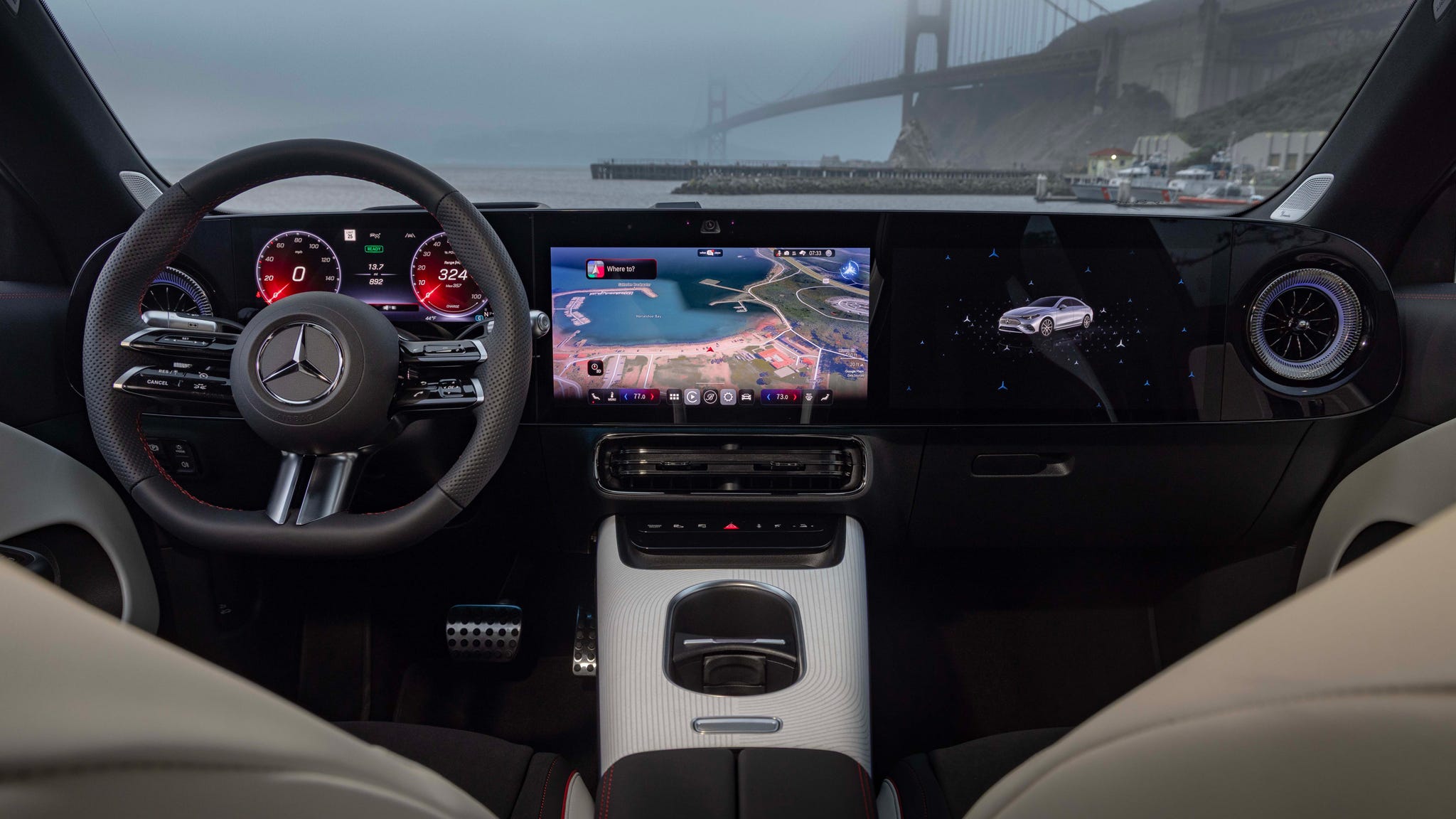
The MB.OS operating system debuts on the CLA, running the fourth-generation MBUX infotainment system. It does its work on Mercedes’ optional Superscreen that spans the interior’s width. There is a 10.3-inch driver display under one pane of glass, and a barely detectable seam between it and the main pane that covers the 14.0-inch center and passenger screens. A large bezel surrounds the screens.
There are haptic buttons for volume, for the parking camera, and for the hazard-lights button and drive-mode selection. Below is a large wireless phone charging pad. USB ports are hidden below the floating center console.
Like Reality TV
The driver’s screen impresses with its ability to show everything going on around the 2026 Mercedes CLA—things like other cars as well as cyclists and pedestrians moving in real time.
The center screen shows a crisp and detailed map with an overlay of arrows indicating when it’s time to make a turn according to the destination entered in the navigation system. There is a lot of redundancy: directions also appear in the driver and head-up displays.

In cars without the active passenger screen, it is static. If the active screen is a feature, the feed to the passenger is cut off if the in-car monitor detects the driver is looking over at it. After less than two seconds, the feed will be cut with a message that the screen has been dimmed to prevent driver distraction. This is where the passenger tells the driver to keep their eyes on the road: the movie was just getting good, and you interrupted it.
The new operating system makes the CLA the brand’s first software-defined vehicle, capable of reinventing itself with over-the-air updates during the car’s lifespan. MB.OS integrates AI from Google as well as from Microsoft.
Sorry, I Don’t Understand You
We were encouraged to engage with the AI-based virtual assistant, developed with Gemini and possessing the combined wisdom of ChatGTP and Bing Search. “She” is activated by saying “Hey, Mercedes,” and the avatar changes colors based on how it reads the driver’s mood: green when content and turning from blue to orange/red for sadness or anger.

We did not have the best of luck. The assistant complied when asked to provide the day’s headlines. Once we had enough, we asked it to stop reading them. But it said it didn’t understand what we wanted. After repeated requests to stop reading the headlines, the system said it would read the headlines and started over. This cycle was repeated numerous times until we tried a new tactic: please play music. It did. And then we asked to stop playing music, a command it also understood. Later we asked “her” if she was ChatGTP—she did not answer and hung up. Perhaps the combination of multiple AI agents in one system for the first time is akin to roommates still feeling each other out.
Mercedes also created a quiet cabin and a menu of Sound Worlds: artificial noises that whirr when you accelerate or interact with the car. Some of the names, like “serene breeze” or “roaring pulse” or “silver waves,” telegraph what to expect. Others are bewildering: “fractal fusion, granular fuzz, and vivid flux.” There are also ambience settings, with names like “pure” and “intense.” The large glass roof adds a nice touch of airiness, and the safety glass has a protective coating against the sun’s rays and heat.