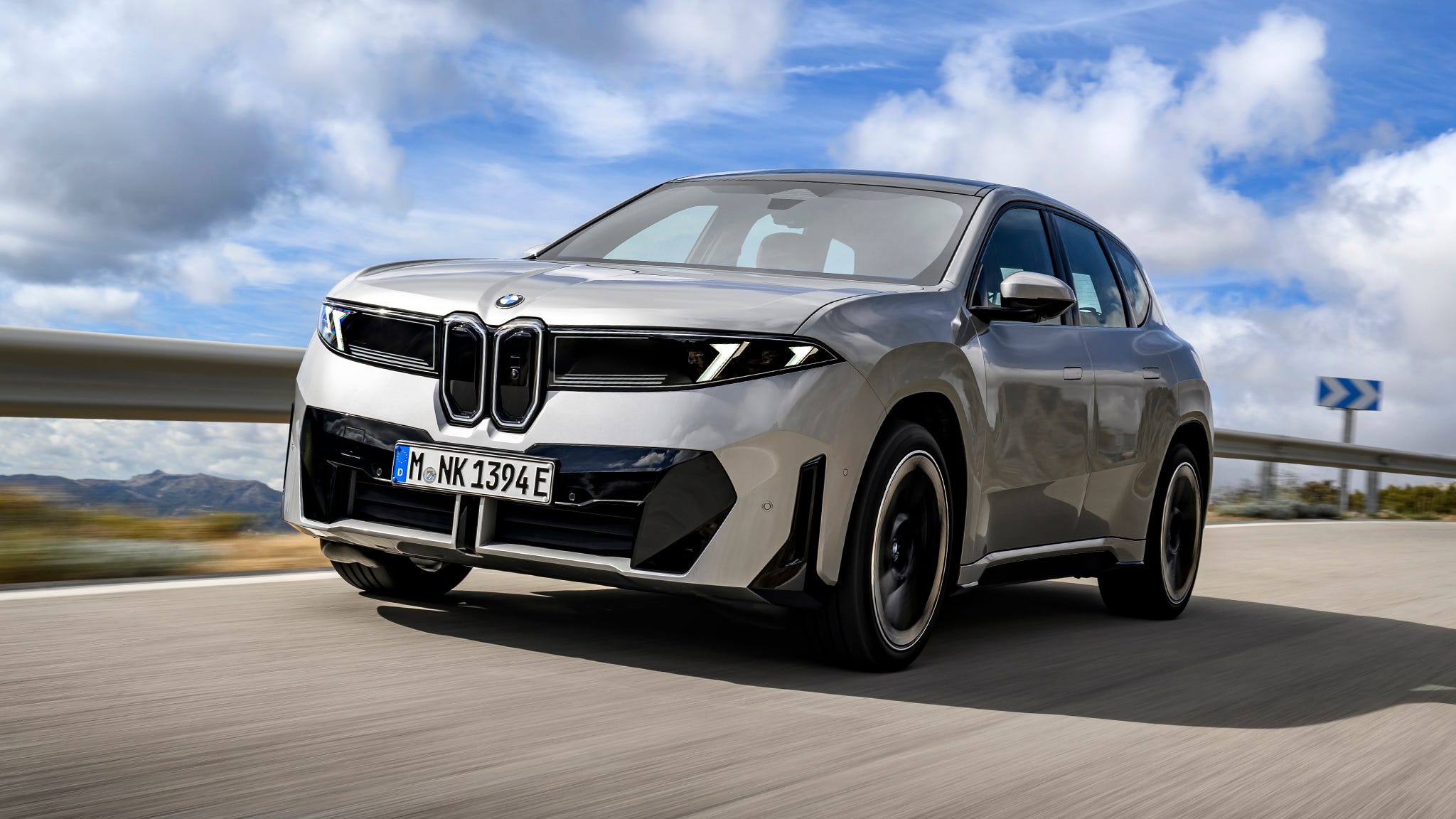
“All new!” That hackneyed expression seldom means what you think in the car world. But in the case of the 2027 BMW iX3, it’s more apt than usual. We’ve extensively covered the iX3’s four-brain centralized computing architecture, noting that this arrangement has computers that receive sensor input directly, then send commands straight to the appropriate actuators. It’s a setup that eliminates the game of telephone most vehicles employ, relaying messages from one supplier’s chip to another’s communications relay, to another’s main controller and back.
BMW built the iX3’s entire system in-house—right down to its antilock-braking actuator. This shrinks response rates from between 10 and 50 milliseconds to 1 millisecond. We travelled to Spain to judge for ourselves how these quickened reflexes pay off in driver satisfaction.
Neue Klasse Recap
Remember that Neue Klasse refers to BMW’s all-new (there’s that term again) electrical/electronic centralized computing architecture. This will be deployed across dozens of next-generation BMWs riding on various physical architectures and employing different powertrains. The iX3 SUV and its coming i3 sedan stablemate ride on BMW’s new KKL (compact class) BEV architecture, with its also new cell-to-pack and pack-to-body construction pioneered by Tesla, in which the carpet and seats are mounted to the vehicle’s rigid battery pack, which bolts directly into a hole in the unibody, improving mass and space efficiency.

Road to Ronda
Our time behind the wheel of the 2027 iX3 began with a spirited drive up the hilly, twisty roads connecting the Andalusian coast with the historic Celtic/Roman/Visigothic/Moorish gorge-straddling town of Ronda. Here, the vehicle’s brain dedicated to driving dynamics, dubbed Heart of Joy, converted our acceleration, deceleration, and cornering wishes into action. It does this by assessing, on a millisecond-by-millisecond basis, precisely how much grip there is at each tire’s contact patch. The Heart of Joy’s bandwidth of capability will be greater with electric powertrains than with the hybrid or combustion variants to which the Neue Klasse electric architecture will eventually be applied. That’s because each motor is essentially a “driving-dynamics actuator” that can accelerate or regeneratively brake instantaneously; there’s no waiting around for gases to enter, compress, and explode.
Is the front axle devoting a big percentage of its grip to cornering? Then those tires won’t accept as much accelerative force, so torque gets biased rearward until the wheel unwinds. These are levers that combustion engines with mechanical drivetrains don’t have access to and that can’t effectively be employed in non-Neue Klasse EVs with a 50-millisecond response rate.
The result: astonishing grip and agility that belies the vehicle’s roughly 5,050-plus pound weight (5,400 or so with two Americans onboard), even when fitted with midlevel 255/40R21 Goodyear Eagle F1 Asymmetric 6 tires like our test vehicle. The iX3’s ability to find and utilize available grip even when there’s spotty dampness in corners is amazing. And of course, each braking stop is electrically managed to be limo-smooth—no bobbing heads.

Hot Lapping Circuito Ascari
Once at the track, we climbed aboard a set of iX3 test cars shod in the top-spec, staggered-fitment 255/40R21 front, 275/40R21 rear Michelin Pilot Sport EV rubber. Improved grip and no worry of oncoming traffic let us fully explore the limits of adhesion—and they’re impressively high. During our session in the Sport driving mode, the G-meter screen logged peak values of 1.24 g in cornering and 1.12 g in deceleration.
Speaking of which, one exercise at the track was to enter an emergency lane change at 78 mph, then stomp the brake pedal as you steer into the other lane, coming to a complete stop in that lane. Here again, the Heart of Joy’s careful apportionment of individual wheel braking forces delivered impressive directional control and stopping distance.
One Promise Unfulfilled
BMW claims that having an intimate knowledge of the grip at each tire allows the synthetic steering-force-feedback system to provide the kind of fingertip tingles that once described micro changes in grip so eloquently in hydraulic steering systems like the vaunted E39 (1996–2003) 5 Series. We so wanted to believe, but nope. Turns out a column of oil transmits nuanced forces in 0 milliseconds, and even the quickest brain needs more time than that to make a calculation and then send and execute a force request. Sport steering mode simply seemed to heavy up the effort, as most other electric power steering systems do.

Cooperative Driver Assists
If you frequently yell at the assist systems in your current newish car, drive BMW’s Neue Klasse cars with an open mind. Cruising the autopista on the way back from the track with the Driving Assistance Pro set to hands-free mode, it became second nature to just look at the side-view mirror whenever it made sense to pass a slower vehicle. This “approves” the suggested lane change, and the system’s driver eye monitor allows considerably longer glances at the mirrors.
The upshot was no scoldings on our drive—not for hands on the wheel (it knows when they are), not for inattention, unwanted coffee-break recommendations, etc. We were allowed to perform light braking and blending into a lane without unsetting the cruise control, and BMW confirmed that all these features will come to the USA. Even better, a City Assistant mode is in the works and will likely roll out to all Neue Klasse cars in the future.