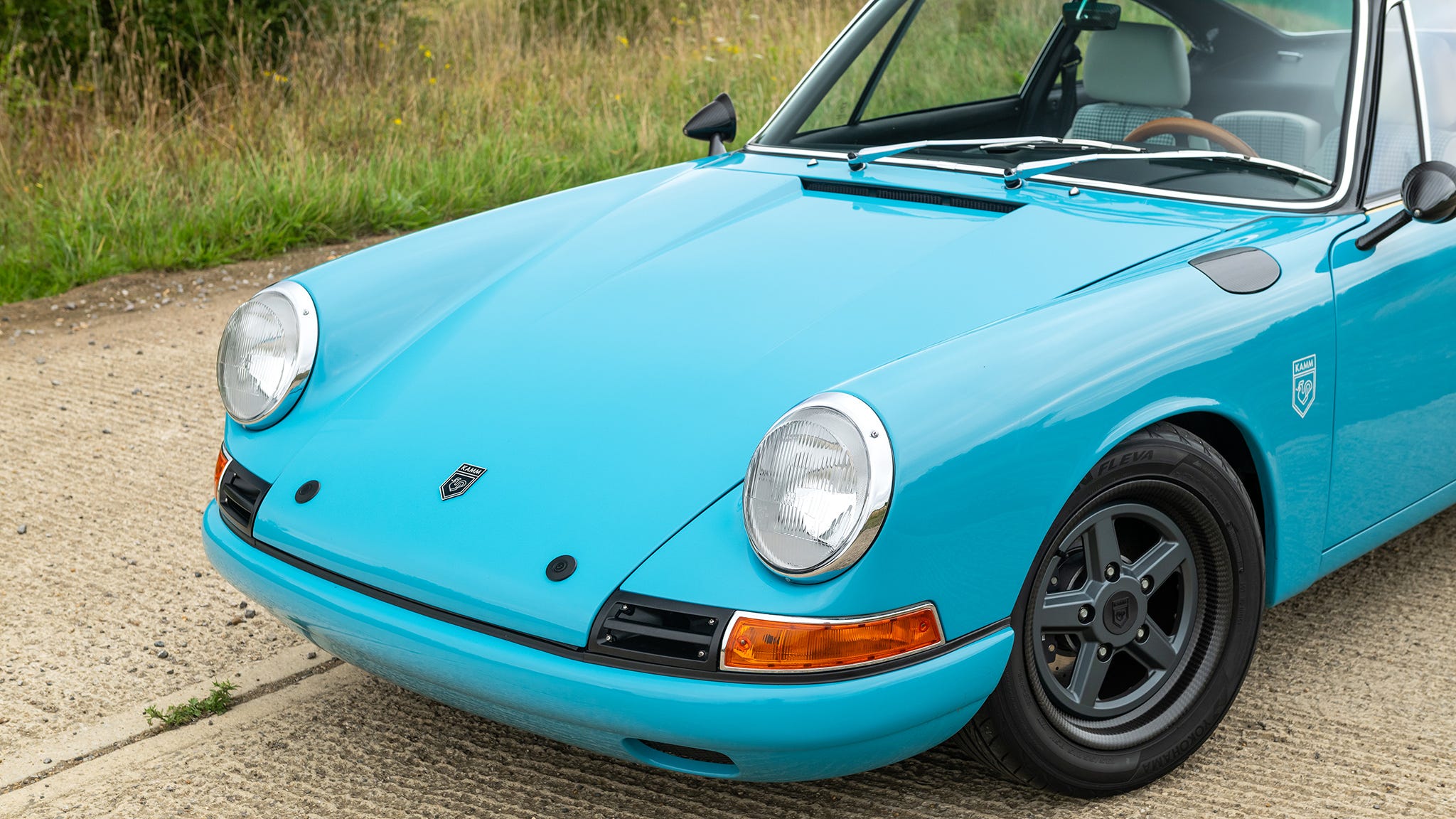
Can less give you more? Unlike the swarm of 911 restomods currently buzzing around on enthusiast wish lists, the Kamm 912C eschews Porsche’s iconic air-cooled flat-six in favor of its lesser known and rarer little brother, the four-cylinder 616 engine. Forget big horsepower numbers, too: The Kamm 912C has just 182 horses nestling under its rounded rump. But it’s propelling a Porsche that can weigh less than 1,541 pounds depending on options. Physics is on its side.
Kamm was founded by Hungarian film and documentary producer Miki Kázmér, a lifelong car enthusiast who grew up in Soviet-era Budapest, Hungary, when sports cars were a rarity. Kázmér worked on cars at a local shop during high school but “diverted away from physics,” as he put it, to focus his studies on the creative arts. He still got his hands dirty, though, restoring a couple of 911s as his movie production career took off, even building a race car for himself.

“I realized that I’m not a race car driver,” Kázmér said of his decision to found Kamm. “I enjoy the passion of building something, but I have too much loyalty to the engineering to beat the shit out of the machine.”
Kázmér likened his role as CEO of Kamm to that of being a movie producer. “It’s my idea, but it’s our collaboration,” he said of the 912C. “I’m the one that has the vision, but I’m not the master of it.” He pointed out that Kamm’s team includes engineers and craftsmen who have worked on special projects for Porsche, Aston Martin, and McLaren, among others.
How Kamm Creates Its Super 912s
Kamm offers four versions of the 912—the 912C, which comes with either a full or partial carbon-fiber body and the 182-hp engine, and the 912T, which has carbon front fenders and hood and a 163-hp engine as either a coupe or a Targa. All cars are based on the four-cylinder Porsche 912 built from 1965 through 1968. Why the 912? “It’s simply a better-balanced car,” Kázmér said. “The four-cylinder engine is shorter and lighter, so the weight distribution is better. The first time I drove a 912, I was amazed how much better it was than a short-wheelbase 911. Obviously the 911 has more power, more torque, and a different sound, but driving-wise the 912 is a better car.”

The Kamm 912C we’re about to drive, a full carbon-bodied car built for a Hungarian client, is a testament to the courage of Kázmér’s convictions. Its base price is more than $460,000, plus shipping and taxes and the cost of a donor car. Surely folks with that sort of money to splurge on a Porsche 911 restomod are going to want the full monty rather than an underdog? “The 911 is irrationally loved by so many people, so you can’t really argue,” Kázmér said. “But the 912 deserves the same. And we are not for everyone.”
Kázmér’s two automotive heroes are the legendary British automotive designers and engineers Colin Chapman and Gordon Murray, and it only takes a few minutes poking around the Kamm 912C to see their influence. This little Porsche is simple, light, and beautifully finished. Both the engine bay and the front loadspace have exquisitely executed carbon-fiber panels and fixtures. The bespoke alternator, located high above the engine ahead of the carbon-fiber shrouding and between the carbon-fiber air cleaner covers, even has carbon-fiber cooling fins. Inside is a dash with bespoke Kamm-branded instruments from Smiths, plus seats and a steering wheel by Fusina, an original Porsche supplier.

In addition to the carbon-fiber front fenders, front hood, and rear deck lid, bumpers, and door skins of the semi-carbon 912C, the full carbon version gets carbon rear fenders and a carbon roof, the panels attached to structural elements of the original 912 body-in-white that have been strengthened with chrome moly steel tubing. Other weight-saving measures include 15-inch, P917-style carbon-alloy wheels that weigh just 10 pounds each, Lexan windows, carbon seats, and a lithium battery that weighs just nine pounds. Lightweight options include an ultra-cool full carbon wheel that looks just like an old-school steelie but weighs less than eight pounds, a 30-pound exhaust system made from titanium and Inconel, and a lightweight AP Racing brake system.
Kamm 912C customers don’t have to be performance-chasing spartans, though. The options list includes air conditioning and a Bluetooth audio system with speakers tucked away under the dash. In addition to these, our test car’s owner has ordered comfort seats, full glass windows, and a transmission with taller gearing, as he wants to use his 912C for more than just the occasional Sunday morning blast along a quiet country road.