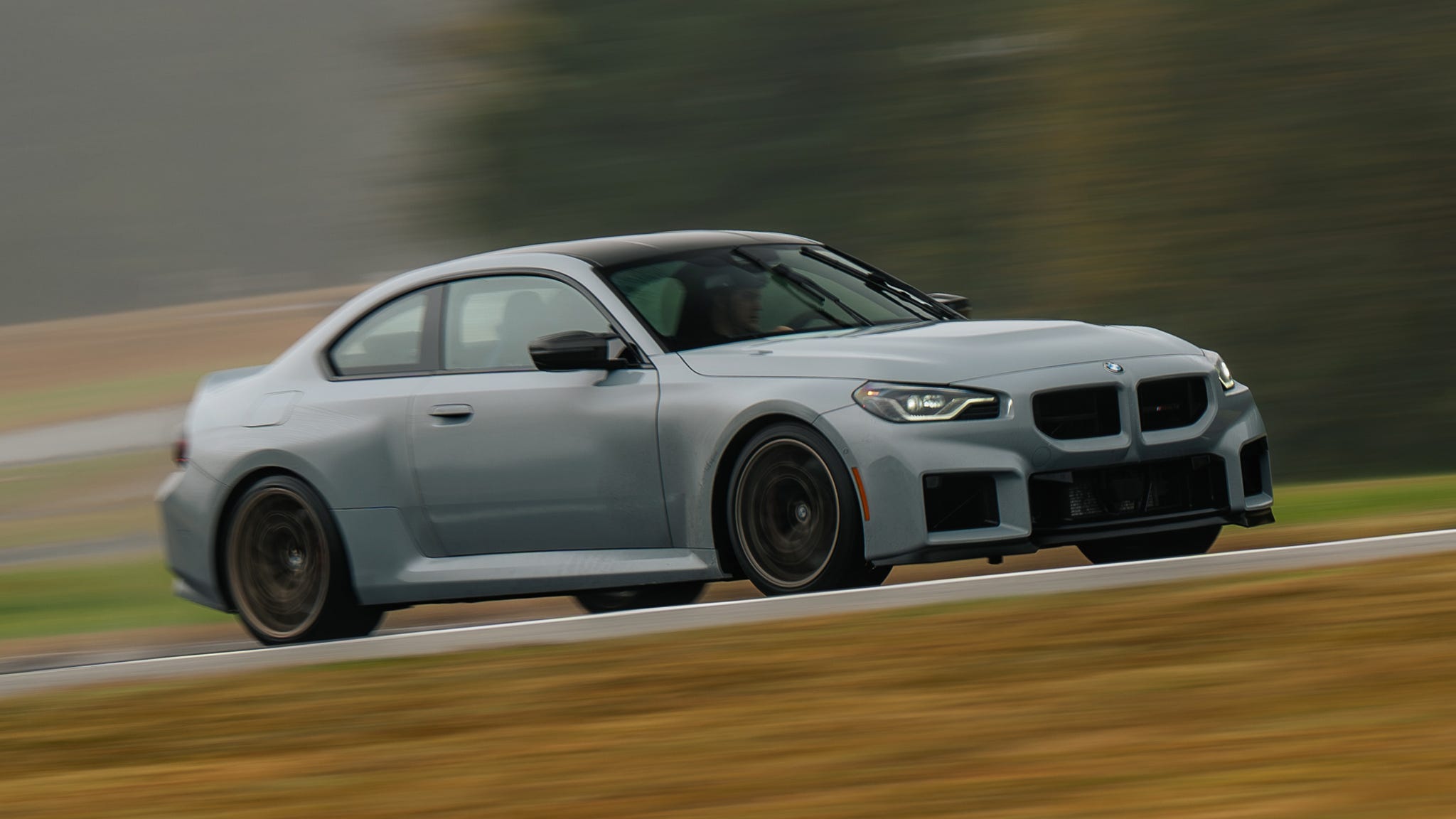
The BMW M2 is MotorTrend’s reigning Performance Vehicle of the Year, and with that program on indefinite “pause,” its reign may be also indefinite. That’s a pity, because the G87-generation car has just gotten a thorough midcycle refresh in the form of the 2026 BMW M2 CS that adds power, strips weight, lowers Nürburgring times, and is positively spoiling for a rematch. How might it fare against the Corvette ZR1, Porsche Cayman GT4, McLaren Artura, and other hot new competitors?
To find out, BMW invited us to its Greenville/Spartanburg area campus in South Carolina for a track drive but decided the BMW Performance Center track wasn’t big enough to stretch its legs, so it rented out the Laurens Proving Ground, where Michelin develops its Nürburgring lap-time record-setting tires (the M2 CS just set such a record for compact cars: 7 minutes 25.53 seconds).

What’s New for the M2 CS
Our M2 CS first look hit the high points, but here’s quick look at what you get:
Engine: The M2’s S58 3.0-liter twin-turbo six-cylinder engine gets an electronic tune that adds 50 horsepower and 36 lb-ft of torque, elevating output to 523 hp and 479 lb-ft. That is, of course, the same output it produces in the M3 and M4 Competition and CS models, but those larger cars weigh more and many feature xDrive all-wheel drive (the M2 is rear-wheel drive).
Performance: The added engine power, plus weight reduction of 97 pounds (opting for carbon brakes cuts another 40), leads to a claimed drop in the M2’s 0–60 time from 3.9 to 3.7 seconds. Top speed rises from 177 mph (on M2s with the M Drivers package, which comes standard on CS) to 188 mph. The last 453-hp 2023 M2 automatic we tested hit 60 mph in just 3.5 seconds, so look for this one to do low 3s. Sadly, rowing your own—as we are with our yearlong M2 six-speed—is not an option for the new CS.
Chassis: Revisions include M2-specific springs that lower the car 8 millimeters (not possible with the M3/M4 xDrive applications), plus specially tuned jounce bumpers. The shocks and engine mounts are shared with the super limited M4 CSL, and the transmission mount is shared with the M4 GT4 race car. The front camber setting is unique to the M2 CS, while the stabilizer bars and rear axle links are carryover M2 parts. And of course, the electronic tuning of the engine, transmission, steering, and chassis controllers are all unique to the M2 CS.
Design: Carbon fiber is used for the roof, mirror caps, rear diffuser, and duckbill-spoiler decklid (it’s painted outside, exposed inside). The front gets a unique grille, air inlets, and spoiler, with gold forged wheels—19-inch front, 20-inch rear—rounding out the look. Just four paint colors are offered: Velvet Blue, Black Sapphire, M Brooklyn Grey, and M Portimão Blue. Inside, there’s an abundant amount of carbon-fiber trim (door panel inserts include CS logos that light up like the M2 CS sill plates), plus an Alcantara steering wheel and sport seats.

M2 CS on the Road
Nobody can complain about the power and responsiveness of the updated M2 engine. Its two small turbos spool up almost instantaneously. Same goes for the transmission. If none of the three adjustable levels of automatic shift-scheduling logic nails your preferred strategy, then simply grab the glorious carbon-fiber shift paddles or nudge the shifter forward and back. It’s a belt, suspenders, and Sansabelt shifting solution.
Folks who fail to conduct a thorough test drive prior to purchase may complain about this interior. For those who fit this hard-shell seat, the connection it provides to the chassis is sublime, though climbing in and out requires some work. And making the headrest pad removable will greatly improve comfort when suited up for battle. The whole center console, upper and lower, is carbon fiber, and there is no semblance of an armrest. So those with hours-long commutes to and from the track may not find a comfortable place to set their inboard elbows. At least the ride quality remains just on the reasonable side of harsh.

M2 CS on Autocross Course
As the photos indicate, South Carolina was in the grip of a determined drizzle/storm during our entire visit. But the autocross course gave us a golden opportunity to explore BMW’s vastly programmable stability control system. Initial laps were run with everything fully on, making it possible to accelerate out of corners very aggressively with little or no deviation from the steered course.
Pressing the M2 button twice and entering the M Setup menu allows one to dial back the amount of traction control. Running at about level eight invites gentle, easily controlled drifts. These got ever bigger until, at level zero, we were flailing at the wheel sufficiently for our fitness tracker to credit a tennis match. Given the safety of our black-lake environs, we then switched DSC off to see how much of a safety net had still been in place with traction at zero. This lap included a full-on spin. Heaven knows what epic speeds and tire trauma would be required to duplicate this experience in the dry …