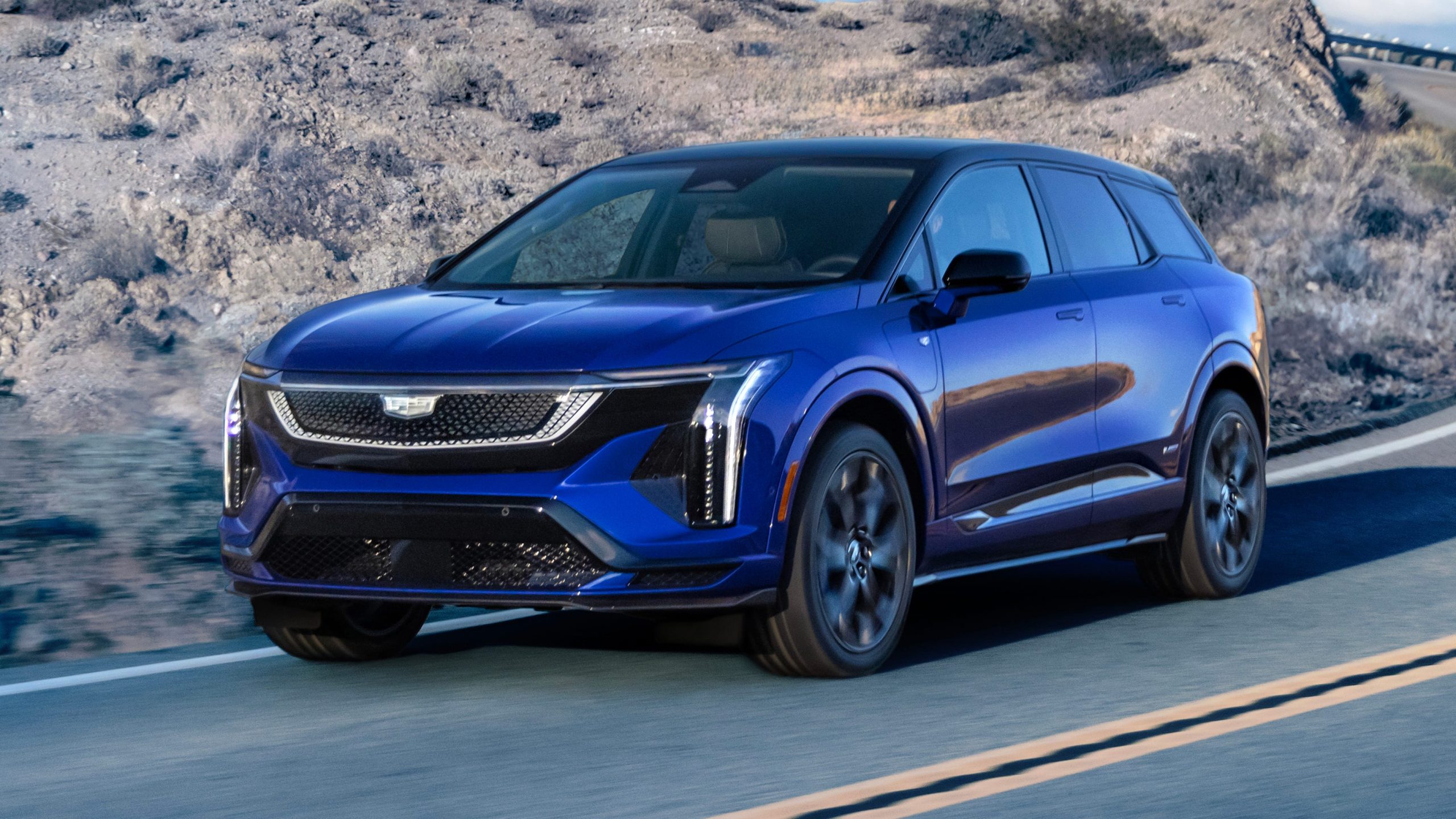
The Optiq-V is most at home on a road—any road—where its strengths are the same as non-V Optiqs. It’s chock full of features, including a 19-speaker audio system with Dolby Atmos and the Super Cruise hands-free system. On broken roads, a faint patter travels through the suspension and into the cabin without ruining comfort. It is quiet and quick and as long as you don’t mind the pops of bright blue trim, the cabin is rich.
An Electric Car, Digitally Developed
Some of this is by design, of course. Remember that V models aren’t supposed to be the razor-sharp racers they once were. That responsibility has been passed on to the V Blackwing cars. Today’s V models target Audi’s S and BMW’s M Sport vehicles—vehicles that prioritize performance upgrades with broad appeal over the driving dynamics nuances that only resonate with enthusiasts. In that context, it’s easy to see how Cadillac arrived at the Optiq-V.

But I also wonder if the Optiq-V’s personality (or lack thereof) is at least partly a product of a digital-intensive development process. GM skipped the prototypes and only built the first cars in the preproduction stage. Instead of early sign-off drives with butts in seats, the team piled into conferences rooms to pore over data from simulations and lab tests of individual components and subsystems. The result, according to chief engineer John Cockburn, was a more rigorous process and stricter adherence to technical facts. Engineers could no longer blame substandard results on prototype build quality.
This faster (and almost certainly cheaper) process didn’t stop the team from making last-minute changes, though. Preproduction cars were already being built when Cockburn made the call to switch from adaptive dampers with external electronically controlled valves to units with internal adjustable valves. The more expensive internal-valve dampers respond faster and with more authority over damping rates. Their value only became clear during a development drive of a preproduction car on Angeles Crest Highway. That begs the question, what else might have changed if the team had been driving cars earlier in the development process. Would the steering be lighter? Would 519 horsepower feel like 519 horsepower? Would the Optiq-V be more uniquely special?
The Power of Personality
The Optiq-V treats more horsepower as a feature rather than a philosophical shift. Even with all the chassis upgrades, it still drives largely like the Optiq AWD at a $13,000 premium. That model becomes a lot more interesting for 2026 as Cadillac has replaced the weak air-cooled induction motor at the rear axle with a powerful, water-cooled permanent-magnet unit. As a result, total system output climbs from 300 to 440 horsepower and the zero-to-60-mph time drops to 4.5 seconds. The AWD model also offers 303 miles of EPA range versus the V’s 278 miles using the same 85-kWh battery.

If these electric V models are going to make us swoon the way Cadillac’s foundational EVs have, they’re going to have break from the mold cast by Audi and BMW. We’re confident that the company that builds the world’s best sport sedans has the expertise to inject more personality and fun into an EV.