Few vehicles balance daily usability and driver engagement better than a sport sedan. More useful than coupes yet less bulky than SUVs, high-performance four-doors mix practicality and dynamism to satisfy the hearts and minds of those who love to drive.
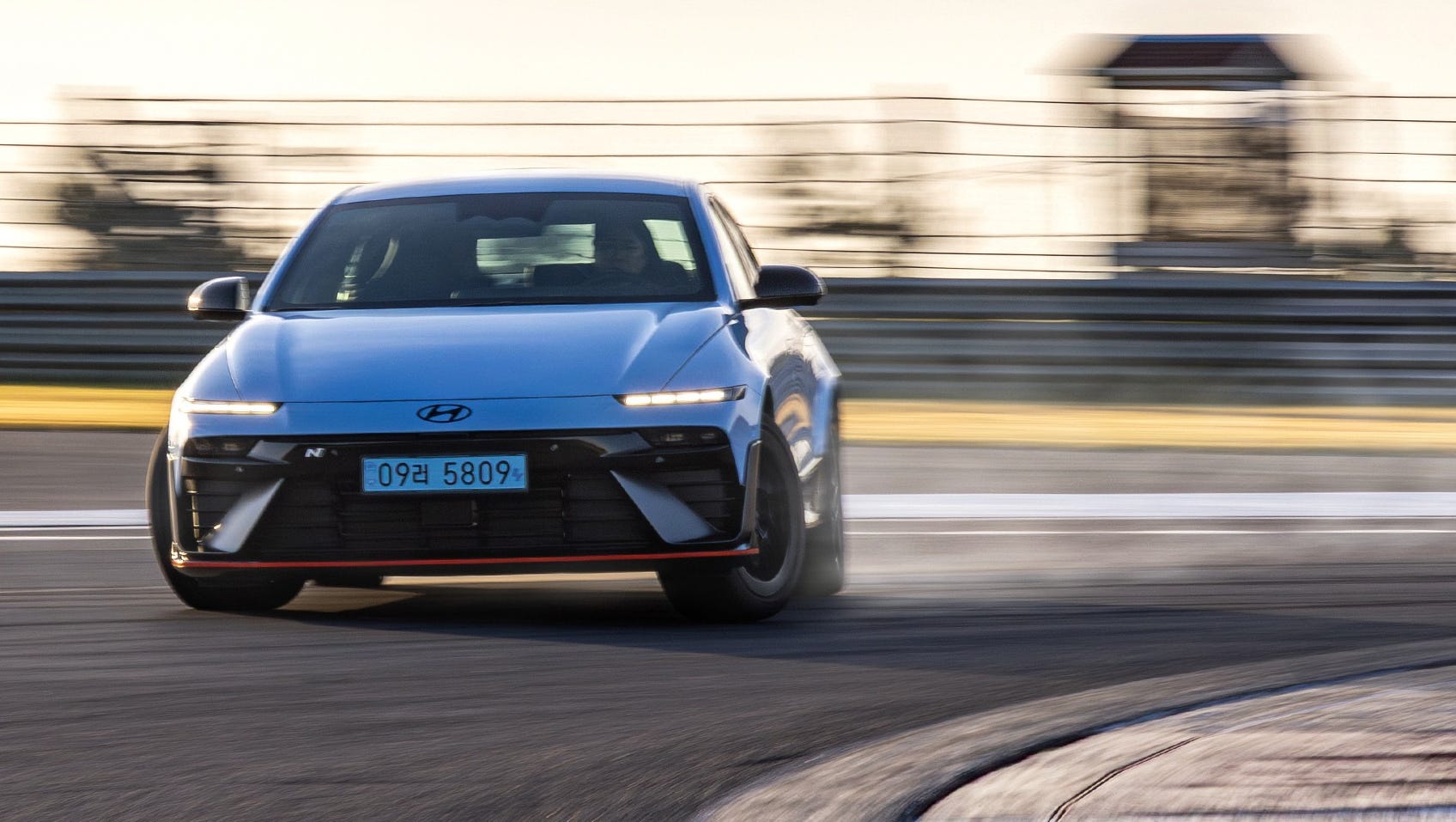
A new entrant is virtually revving up to join this star-studded category: the 2026 Hyundai Ioniq 6 N. It’s a riotously fun and focused model that’s been developed to rival icons from Europe, Japan, and the United States—that is, if you gas-huffing purists would just look past the plug.
Having now driven the Ioniq 6 N on the road and at a racetrack, take it from us: You’ll want to.

Increasing N-Gagement
Once a bit frumpy, the Hyundai Ioniq 6 lineup as a whole gains a bold countenance in its 2026 update. The new look nearly transforms this EV, as its once wide-eyed headlights narrow to an LED-accented glower. Below, the grille opens into a performance-implying maw that’s showcased on the new N Line trim, which is essentially a styling package. The Ioniq 6 N (no Line) cranks up the visual aggression further—but more than just looking fast, it’s been modified extensively to go fast, too.
Much of the 6 N’s high-performance engineering is cribbed from the already stupendous Ioniq 5 N SUV, which arrived for the 2025 model year and quickly started breaking performance records, winning comparison tests, earning tech accolades, and generally providing nothing less than glee to everyone at MotorTrend lucky enough to drive it.
Primary among those mechanicals is the dual-motor powertrain, which delivers 641 hp and 568 lb-ft of torque in short bursts (it’s rated at 601 hp and 545 lb-ft most of the time). Traction at the rear is optimized by an electronically controlled limited-slip differential. But don’t think for even as long as it takes to sprint to 60 mph—likely less than 3.0 seconds—that the Ioniq 6 N is just an electric muscle car. Its chassis has been thoroughly revised with adaptive suspension dampers, hydraulic bushings, and additional structural adhesive to increase feel and precision. Bespoke wheels spin beneath its widened body, and appropriately big brakes haul it down.

Don’t think, either, that the Ioniq 6 N is merely a sedan-ified Ioniq 5 N. Compared to its crossover counterpart, the 6 N has bracing struts between the trunk and back seats to increase torsional rigidity. Although ground clearance is identical between the two, the 6 N’s shorter height contributes to a roll center some 4 inches below that of the 5 N. There’s also the swan-neck rear wing, which the 5 N lacks; it can push more than 200 pounds of downforce at a top speed of about 160 mph.
Hyundai says it attempted to give the 6 N a different character than the 5 N: less wild and playful, more grip-oriented for added control and precision on track and off. A configurable drift mode in the 6 N ensures things will never be too stoic if you so desire—as if that could possibly be a concern for a vehicle so inherently spirited as this.
N-dless Choices
Sports cars were once simple machines, their dynamic breadth defined by hardware. No more. Of course, metal still matters greatly, but now, endless reams of software code are often just as vital if not more so to shaping a car’s tangible properties.
In the Ioniq 6 N, that tech can sometimes feel overwhelming. There are so many settings: multiple levels for motor response, steering weight, suspension firmness, differential behavior, and stability control leniency. Each can be tuned independently. That’s even before you get to N Torque Distribution or N Pedal, which lets you adjust torque balance and regenerative braking strength.
While there’s theoretically a finite number of configuration possibilities, it’d take a lot more time than we had to find the perfect one. That’s of little concern, though, since the Ioniq 6 N is so fun regardless of how it’s set up (OK, maybe not Eco mode).
Running as the EV it is, torque arrives instantly and power sustains up to high speeds; the straight between Turns 3 and 4 of the Korea International Circuit we had the pleasure of attacking in the 6 N wasn’t long enough to exhaust it. Like with any EV on Hyundai’s now ubiquitous E-GMP platform underpinnings, the acute regenerative braking capability allows for a satisfying flow between curves by simply modulating the accelerator.

Like the Ioniq 5 N, though, the 6 N offers an amazing trick: imitating a combustion car. Press a button, and the motors recalibrate to feel like an engine, with a surge that rises across a defined powerband. A tachometer appears, and the steering wheel’s paddle shifters now change virtual gears that dictate how acceleration is delivered. Don’t upshift, and it’ll bounce off a synthetic rev limiter; don’t downshift, and it’ll lug. It’ll even deny downshifts at high rpm, lest you over-rev the engine it doesn’t have.
Hyundai programmed the 6 N’s “transmission” to have tighter gear spacing than the 5 N. The effect is of a close-ratio eight-speed box that encourages constant paddle slapping. It’s all optionally accompanied by one of three digital exhaust notes, adding an audible reference point to promote focus on the road as it rushes toward you.