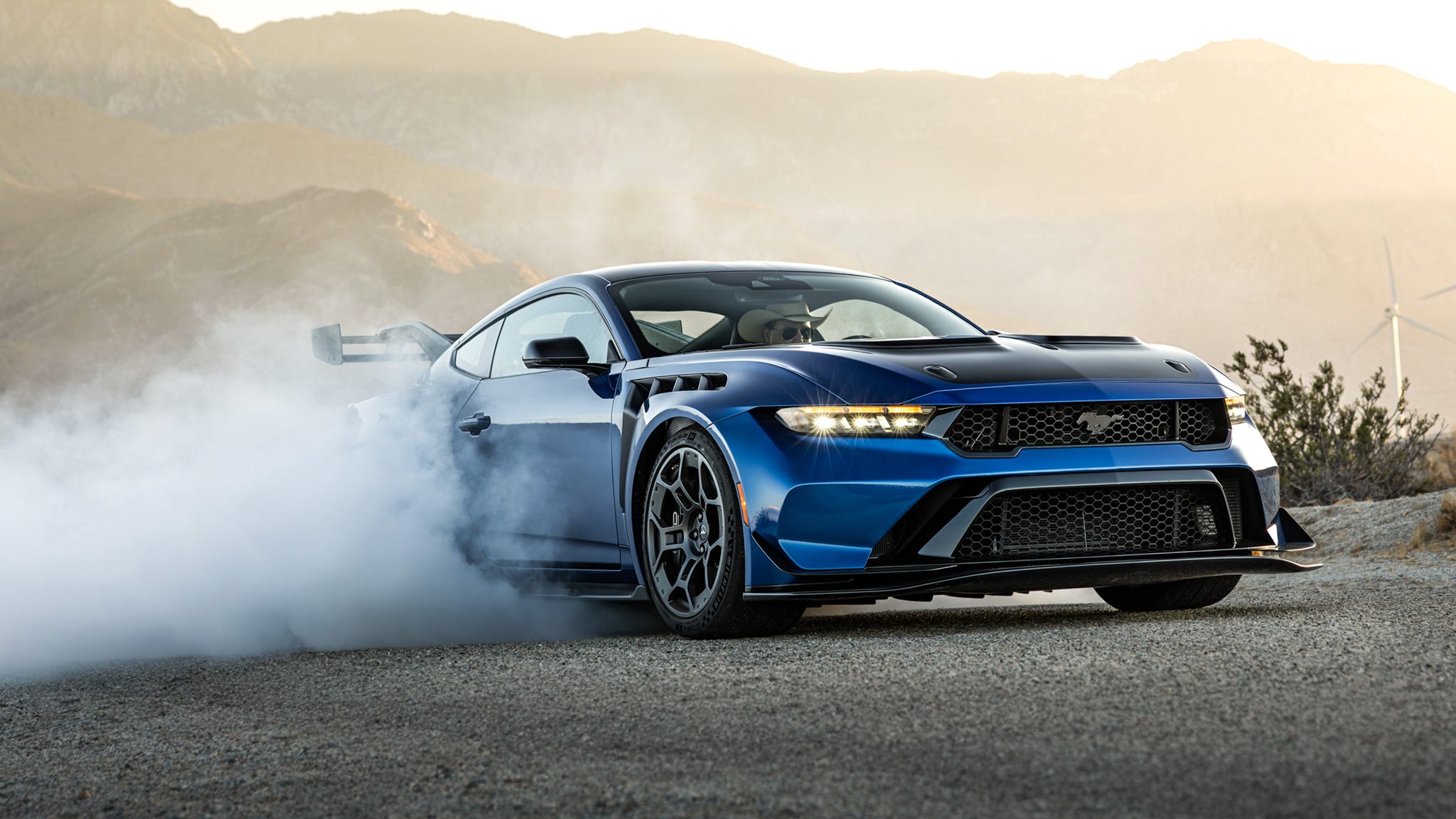
Die mad, haters. “It’s lame,” you cried. “The GTD is too big and too fat, and its Nürburgring time wasn’t fast enough.” Yeah, and? There’s exactly one thing wrong with the 2025 Ford Mustang GTD, and it ain’t the weight.
Worth the Weight
4,386 pounds. That’s the number. Ford didn’t really want to advertise it, but enthusiasts dug a lower number out of EPA certification documents, and the company has finally clarified it. It’s roughly 400 to 500 pounds heavier than a Mustang Dark Horse depending on options and nearly 1,200 pounds more than a Porsche 911 GT3 RS, the car Ford couldn’t shut up about beating with the GTD.
Seems bad, but it isn’t. You’d never know it weighed that much from behind the wheel. Not on the street, not on the track. At no point does the GTD feel heavy. The perceived weight of the car is no different than the Dark Horse, and it imparts feelings of solidity and stability, not laboriousness or dullness. Even the electric power steering system delivers feedback good enough to fool most drivers into thinking it’s hydraulic.
In fact, the GTD is shockingly easy to drive fast. It is so planted, so settled, and so confident, anyone can get in it and go fast. The grip exceeds what even the experienced supercar driver expects in cornering, accelerating, braking, or any combination thereof. The only street car that compares is, unsurprisingly, the 911 GT3 RS.
As it happens, both Ford and Porsche held their premier driving events at the same track, the Thermal Club. They even used the same track configuration, and I attended both, making me one of the few people who can directly compare them, albeit two years apart. Sounds like a lot, but there are only two corners on the track that matter for our purposes, the longest one and the tightest one. It’s in those turns, these cars tip their hands.
The first is the never-ending bowl, a constant-radius left-hander where any car will understeer wide if you carry even a little too much speed. It’s where both the GT3 RS and GTD prove their downforce claims. In 99 percent of street cars, claimed downforce is effectively meaningless as it typically doesn’t apply until speeds you struggle to reach even on a racetrack. These cars are the exception. The amount of speed you can carry, the amount of lateral g’s you can pull, puts other cars to shame. No other street cars go around this kind of corner so fast, and it’s a combination of tires, suspension geometry, and downforce that makes it possible. That the big, heavy Mustang could feel just as fast and capable as the featherweight GT3 RS in the same corner is a monumental achievement.
The second is less a corner and more an angle. It’s so sharp and so acute, it might as well be a triangle. You crawl around it at what feels like walking speed. Try to enter too quickly, and you get massive understeer. Get impatient exiting, and it’s wild oversteer. This is the corner that caught out the GT3 RS, where low speed means no downforce, and, suddenly, that incredible front-end grip was reduced to relatively paltry street car levels. Only perfect execution would avoid understeer.
Not the Ford. Between its absurdly broad, 325-width front tires and an aggressive factory spec’d track alignment, the GTD wouldn’t let go. It took massive, deliberate trail-braking and sharp steering input to get a little push as I entered the corner. On the way out, the even more ridiculous 345 rear tires and crazy rear suspension put the power down in ways you can’t believe when 815 horsepower and 664 lb-ft of torque are part of the conversation.
Only at the end of my lapping session, when the tires were worn out, did I provoke significant oversteer by deliberately going hard on the throttle super early with tons of steering still dialed in. Even then, Ford specified a custom Michelin Pilot Cup 2 R with a very progressive breakaway, so the car never snaps out. It rotates and it drifts, but it doesn’t try to put you backwards in a ditch.
How much the rear end will swing depends on the new Variable Traction Control feature. Accessed by holding down the ESC off button and adjusted with the cruise control buttons, it offers five settings and a full-off position. You only feel it working in the full-on setting and only if you’re trying to get the car sideways. In its lowest setting, it acts as a safety net when you do get the tail out. We had zero concerns about running it full-off as simply lifting or upshifting during a power oversteer easily brought the rear end back in line. Or leave the shifting to a computer just as clever as the one that controls Porsche’s PDK, and power oversteer becomes even less of a concern.
Those barely road-legal tires and the massive Brembo carbon-ceramic brakes that slow them have no trouble dropping velocity, either. I lapped the GTD in 85-degree heat without a hint of brake fade, curb weight be damned. The pads bite hard and immediately, the pedal requiring a light touch but allowing you to modulate pressure constantly as you feel out the braking zone. What’s more, the car is impressively stable under hard braking, even over bumps, which, along with the tame limit behavior, sends driver confidence through the roof. The first time you go around a corner fast in the GTD, you know you have nothing to worry about.
At no point does it feel light and nimble in the manner of the GT3 RS, but it doesn’t matter. It’s just a different way of getting the job done equally well.
One For the Road
The GTD’s poise and confidence on the track carry over to the street, too. Bumps don’t matter, whether they’re in the middle of a corner or a heavy braking zone. Carry too much speed into a corner? Just turn more, or trail-brake more, or both. The car doesn’t care. The GTD will gladly save you from yourself without breaking a sweat. This car is so forgiving, wrecking it would take a monumental act of bad driving.
It ain’t bad on the back, either, which is far more than the Porsche can say. Driving a GT3 RS on a California freeway can be classified as a form of masochism. You could say the same about the GTD, if you forgot to take it out of Track mode or turn off Sport damping mode (or both). Like the Ford GT before it, the GTD’s track mode stiffens both the shocks and springs, the latter by literally compressing the softer of the two springs at each corner with a hydraulic ram, leaving only the stiffer spring able to move. Uncork it and turn down the dampers, and the ride quality is considerably worse than that of a Dark Horse but noticeably better than a GT3 RS’s.
What’s Wrong With It, Then?
You already know, because you’ve seen the photos. That’s a $40,000 interior in a $325,000 car. The design and materials quality of this generation of Mustang have underwhelmed from the start, and little has been done to update it for the GTD. The Recaro seats are the biggest addition, and they creak under heavy cornering loads. The bolstering and comfort, at least, are excellent.
Otherwise, it’s some carbon-fiber trim on the dash and around the flimsy dial shifter (which really needs some stops in it when you get all the way to drive or park) and an updated Dark Horse steering wheel. Those consist of some red buttons instead of silver, sueded leather inserts on the rim, and a sueded leather stripe at the 12 o’clock position that’s already had its color worn off in our car, which has 6,000 test miles on the odometer.
Finally, there’s a new Track button next to the engine start/stop button, which brings up a special menu on the infotainment screen. Here, you’ll find the ability to turn on and off the active aerodynamics, the launch control, the line lock burnout feature (limited to 15 seconds), and all the performance trackers. Since Ford won’t reveal the 0–60-mph time, we used the acceleration timer to record a 3.38-second best run on an unprepped surface, which we think could be brought down closer to 3.3 with fresh tires and enough attempts.
The glass is all shared with other Mustangs, which helps keep interior noise levels down. Rearward visibility is almost nonexistent until you pass 35 mph and the rear wing opens.
Weight savings were instead found in reducing some of the coatings under the carpet. Ford says it didn’t touch the thermal barrier, but your right leg still gets painfully hot after a few hours of driving.
All in all, though, the interior is wildly underwhelming for the price. Ford will no doubt make the argument that every dollar went into performance, and we don’t doubt it. That doesn’t mean, though, that this is what customers of $325,000-plus cars expect. Still, it would appear to be a moot point as Ford has received roughly four times as many applications from prospective buyers than it has announced build slots. (The GTD is only confirmed for the 2025 and 2026 model years, though Ford said roughly the same thing about the Ford GT, and it’s still technically in production seven years later.)
What’s a GTD?
Ford’s maxed-out Mustang is a lot of things. Ford marketing calls it “a supercar with the soul of a Mustang” and has positioned it as a road-legal version of the Mustang GT3 race car but better. That kind of boasting feels like setting the car up to fail, but the parts list backs it up.
The name derives from the GT Daytona class in IMSA racing, essentially America’s version of the FIA’s international GT3 class. The Mustang GTD shares far more than a name with the race car, though. Both use the same chassis as a standard Mustang, in this case diverted from the production assembly line in Michigan to race car and exotic road car builder Multimatic in Ontario, Canada, where the rear fenders, trunk, and rear seat area are cut out.
The trunk and rear seat volumes are filled with an eight-speed dual-clutch transaxle with an integrated electronically controlled limited-slip differential (cargo can go behind the front seats, but that’s it). Above and around that lives an integral-link rear suspension with pushrod and rocker-arm-actuated springs and Multimatic ASV electronically controlled spool valve shocks. Pushing the transmission to the rear of the car improves the weight balance to a neutral 50:50.
A hydraulic system mounted where the trunk used to be (alongside the transaxle cooler, fans, and ducting) compresses the softer springs at all four corners when Track mode is engaged, lowering the front 1.6 inches and the rear 1.2 inches. Similarly, the hydraulic rams in the front shocks raise the nose 1.6 inches when the front axle lift is engaged by moving in the opposite direction.
The hydraulic system is also employed to actuate the active aerodynamics. The rear wing opens above 35 mph in most scenarios to reduce drag, closing as the computer sees fit to increase rear downforce. Likewise, the computer opens and closes flaps under the front of the car to increase or decrease front downforce. There is no way to manually actuate the aerodynamic devices, although you can turn them off, which leaves them in high-downforce mode.
Providing both mechanical and electrical power is the latest iteration of Ford’s Predator 5.2-liter supercharged V-8. It now features a dry-sump oiling system, the aluminum tank for which is a structural element helping mount the power take-off that connects to a carbon-fiber drive shaft. The oiling system, along with raising the redline another 150 rpm from the last iteration in the F-150 Raptor R, helped bump power to new heights. A secondary “surfboard” intake over the top of the primary engine air intake allows the 2.3-liter supercharger to breathe deep enough. It’ll drain the 16-gallon fuel tank in less than 200 miles driven nicely, much sooner driven like it’s supposed to be. Plan accordingly.
A Ford Racing strut tower brace over the engine is the most visible of the additional chassis bracing.
The optional Track package seen here adds the active aerodynamics (which are otherwise fixed), the longer front splitter, the dive planes on the nose, and the “hood flicks” at the leading edge of the hood vents. Ford won’t disclose a price for the package. The mesh in the hood vents can be easily removed to increase airflow at track events, and Ford encourages you to do so.
Lighter magnesium wheels will eventually be an option, although Ford won’t say when or how much they’ll cost. The standard wheels are forged aluminum and were used for the Nürburgring record attempts.
Finally, the bodywork is almost entirely replaced with carbon fiber. For crash safety, the roof rails must remain metal, and for cost reasons the door skins stay metal, too. Unless, of course, you pay an undisclosed amount for the Liquid Carbon package, which replaces them with carbon fiber, as well, and saves 30 pounds (as well as getting rid of all the paint and making almost the entire exterior exposed carbon fiber).
You’re Too Late
Ford has closed its application system, so if you haven’t gotten yours in already, it’s too late. On top of that, GTD team members tell me they’ve already selected all the successful applicants and will be reaching out to them in the next few months inviting them to place orders. Technically, that means they’re not all sold yet, but it’s a distinction without a difference as Ford has plenty of backups if anyone declines their invitation.
How much those lucky few will pay will be between them and Ford. The company wouldn’t share any pricing beyond the base of $325,000. Beyond the optional wheels, the active aerodynamics, and the Track package, most of the options are cosmetic. Whether they’ll push the car over $400,000 remains to be seen, but we won’t be surprised if it happens.