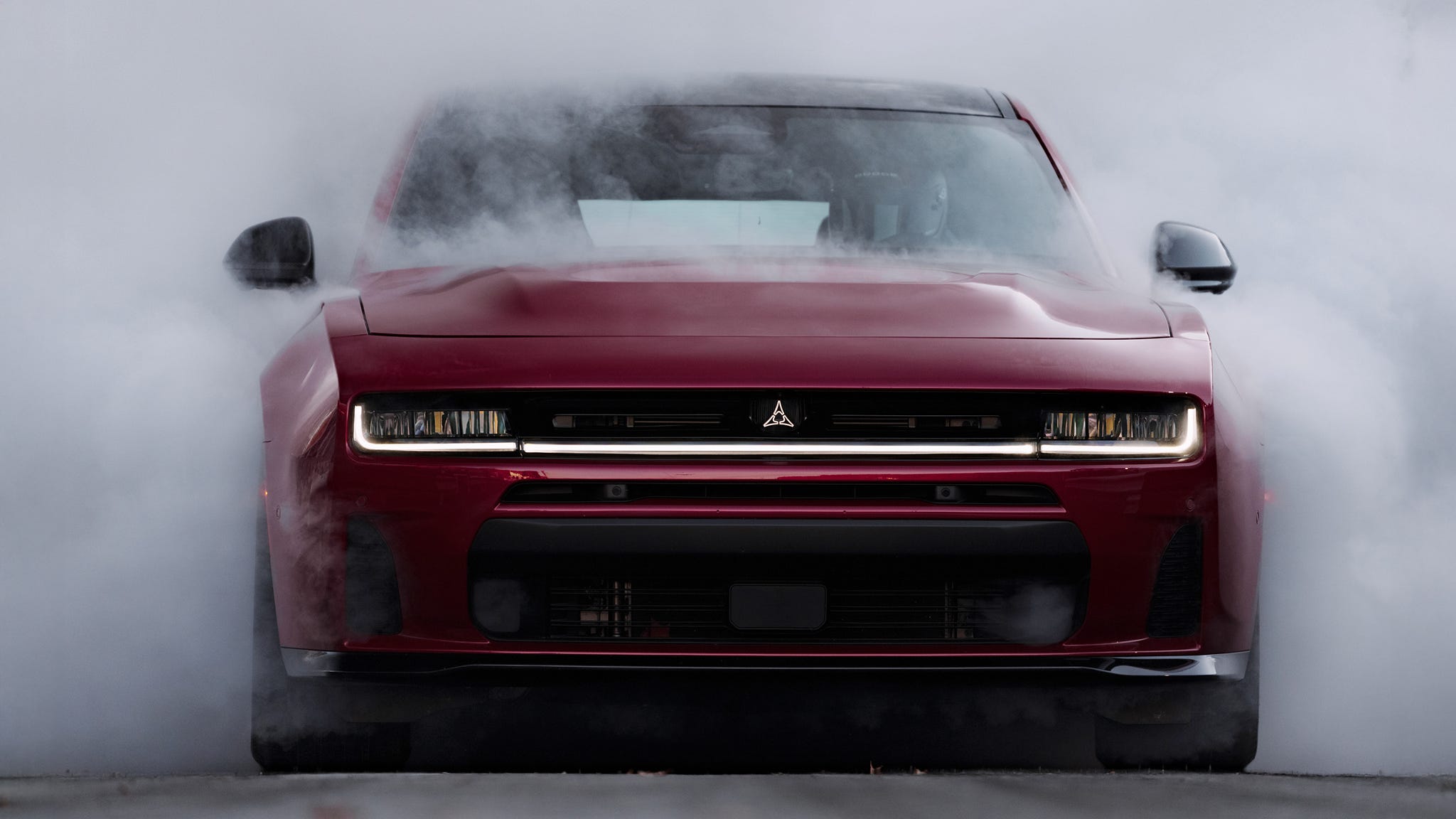
The new Dodge Charger is a deeply confounding car. There is no denying the laundry list of faults we found in the Daytona EV, yet despite them, its innate charm worked magic on many of our editors. You sense there’s a fundamentally good car in there somewhere, and you want to root for it rather than savage it. The 2026 Dodge Charger Scat Pack with the Sixpack twin-turbo inline-six is a better car in some ways and simply a different car in others.
Fixing Faults, Righting Wrongs
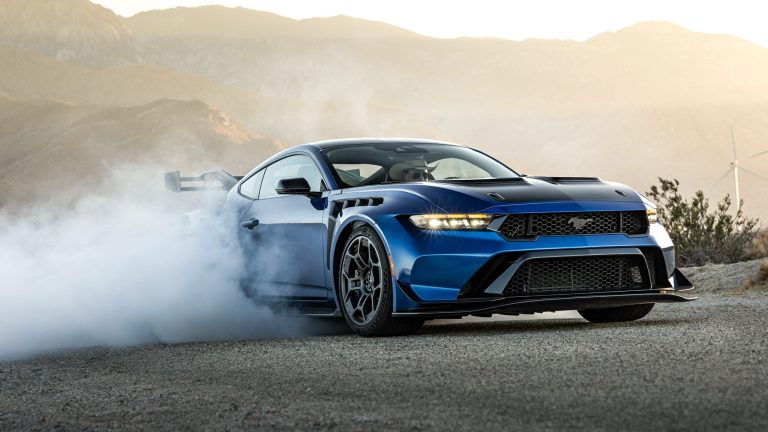
At a base level, the gas-powered Sixpack resolves the EV’s biggest weaknesses. It’s significantly lighter, it goes much farther on a tank of gas than the EV does on a full battery, and it gases up in minutes. More than that, it makes real noises and does big, smoky burnouts. The Daytona EV may be a good car deep down, but it wasn’t the car the Charger (and Challenger) faithful wanted. The Sixpack is, almost.

Beyond tailpipes and a slightly different front end, the gas-powered Charger Sixpack and EV Charger Daytona are nearly indistinguishable from the outside. From the inside, they’re virtually identical. How they drive and the emotional responses they elicit, though, are markedly different.
The EV is inescapably quicker in a straight line, especially from a roll, and its motors are more responsive in all situations. Its weight and lower center of gravity also make it feel more planted on the road. Losing roughly 1,100 pounds, though, makes the Charger Sixpack noticeably nimbler. (Yes, there’s a big, empty cavity under the car where the EV battery pack would go.) The EV was the best-handling Charger or Challenger Dodge has ever built, and it cedes that crown to the Sixpack. With so much less mass needing to change direction, it feels more like a sport sedan than a straight muscle car. A really, really big sport sedan. Like, “longer and wider than a Toyota Sienna minivan” big. It’s sporty in the way an AMG S63 is sporty.

Highly Combustible Situation
The focus of course is the twin-turbo Hurricane inline-six under the hood, rebranded as the Sixpack here. In this Scat Pack model, it’s good for 550 hp and 531 lb-ft of torque. An R/T model coming next year will offer 420 hp and 468 lb-ft. In the Scat Pack, the engine mates to an eight-speed automatic and a wet-clutch transfer case sending power to all four wheels. Rear traction is aided by a standard mechanical limited-slip differential. The redline is unusually low for an engine like this at just 6,000 rpm, but Dodge says it got everything it wanted out of this engine with that redline, so there was no need to raise it. Not to say they couldn’t for a future model, though, and make even more power.
Dodge also says it’s all good for a 0–60-mph sprint of 3.9 seconds and a 12.2-second quarter-mile elapsed time. We’ll see what times we get once we test it, but a trio of passes down an eighth-mile dragstrip revealed the car is remarkably consistent, with each run varying by only a few hundredths of a second. It’s mildly annoying that the launch control is buried several menus deep, but once you have that screen displayed it’s easy to use at the tree.
The line lock feature is far more convoluted, requiring you to stand on the brake, then press and hold the OK button on the steering wheel, release the brake but not the button, then floor the gas while still holding the button. Release the button, and you can roll out of it, but release it before the wheels are spinning, and it’ll cancel the whole thing. Pat your head and rub your belly enough, and it works as advertised, but it’s a lot of steps to do a burnout.

All warmed up and launch-controlled, the Sixpack feels strong off the line. From a roll, it’s less impressive as the weight of the car, around 4,800 pounds, makes itself known. Rather than squeeze the throttle, step on it and make the transmission drop a gear. Below 2,300 rpm it’s lag city, but once the turbos hit (or are spiked by the downshift) and all 30 psi are unleashed on the pistons, it surges ahead with authority.
The transmission generally gets it right, but you can catch it out of sync coming out of tight corners, even in Sport mode. The paddle shifters fix this, even if they are way too tiny, and it’s a true manual mode that won’t auto upshift at redline. We like that, but it does keep you on your toes because 6,000 rpm shows up quick in the lower gears.
How much power is sent forward, meanwhile, varies depending on all these modes. Left to its own devices, the car sends 50 percent of the power forward. Clutches on the front axle can disconnect it in the interest of fuel economy, but in general, it’s an all-wheel-drive car. Select Sport mode, and the torque split changes to 40 percent forward and 60 percent rear. Other ratios could come in the future with software updates. Once you’re in Sport, you can select rear-wheel-drive mode and send all the power to the back, but think carefully before you do that.