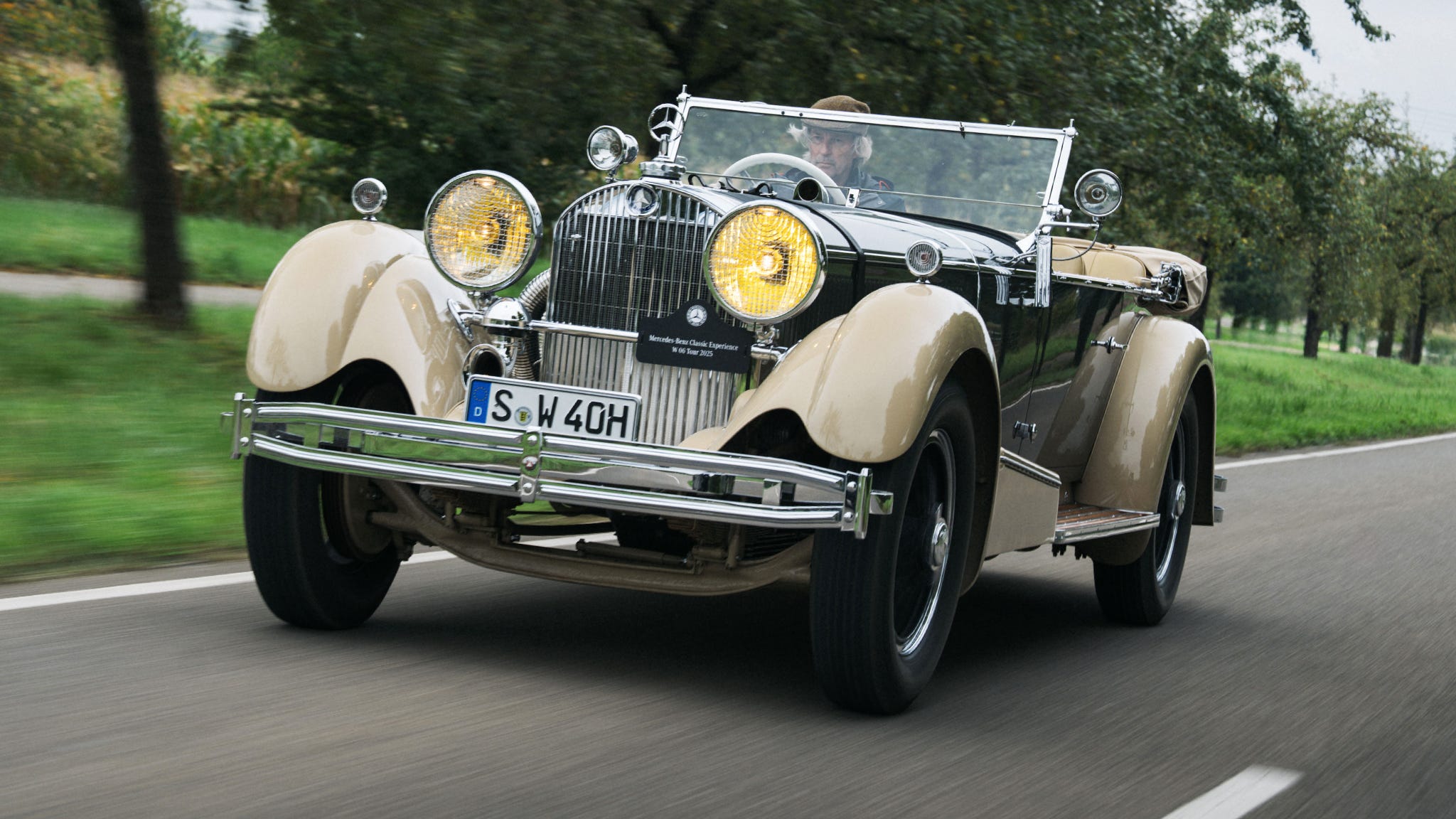
I looked out over the giant, white-rimmed steering wheel at the phalanx of supercharged W06 Mercedes-Benzes on the banking ahead, exhaust pipes cascading along the right-hand side of their hoods, three-pointed stars glittering high atop their grilles. All were built between 1926 and 1933, and at the time were among the fastest road cars money could buy. “How much is one worth now?” I casually ask my passenger, Marcus Breitschwerdt, the head of Mercedes-Benz Heritage. “One not in top condition, probably $5 million,” he says, “and a good one $10 million.” I gulp. “And this one?” I ask of the hulking SS tourer in which we’re sitting. “Because of its history, probably $25 million,” he says, perfunctorily.
Ahhh… so, I’m about to drive a vintage Mercedes-Benz with a giant supercharged engine, languorous drum brakes, and a four-speed transmission built before they invented synchromesh, a car now worth almost 10 times as much as a Mercedes-AMG One hypercar cost when new. What’s more, I’m about to drive it out of the calm confines of the Mercedes-Benz test track, into the Stuttgart area’s Saturday afternoon traffic, and back along a mix of autobahn and country roads to our hotel in the scenic hills of Baden-Württemberg. No pressure, then.

Model S Before S-Class
Long before the Mercedes-Benz S-Class was the three-pointed star’s premier luxury car, there was the Mercedes-Benz Model S. Launched in 1926, the Model S was designed as a fast and powerful sports touring car, powered by a 6.7-liter, supercharged inline six-cylinder engine that developed 140 horsepower in normal running mode and 180-hp when the supercharger mounted vertically at the front of the engine was engaged. The Model S was superseded in mid-1928 by the Model SS, which featured a 7.1-liter version of the straight-six that produced 200 hp with the supercharger blowing the fuel/air mixture into its giant combustion chambers. That was two to three times the power of most cars on the road at the time, enough to propel the Mercedes SS to what was then an otherworldly top speed of almost 120 mph.

The Mercedes SS I’m about to drive was built barely a quarter mile away, in 1930 at Mercedes-Benz’s storied Sindelfingen factory. It was shown at the Paris Motor Show in early October that year, and Mercedes-Benz Heritage records reveal it had gray bodywork and champagne-colored fenders over the chassis it wears today, along with leather seats and burr walnut trim. After the Paris show, the car was converted from left- to right-hand drive at the request of its owner, Hari Singh, the Maharaja of Jammu and Kashmir. The car was shown in this layout at the Berlin Exhibition in February 1931 before being officially handed over to the Maharajah.
Hari Singh liked the finer things in life. Crowned in 1926 Maharaja of the stunningly beautiful kingdom of Jammu and Kashmir (now the southeastern part of the Kashmir region, control of which has long been disputed between India, Pakistan, and China), he had an annual income of almost $200 million in today’s money, flew in a silver-plated plane, and lived in a Versailles-sized palace (now the LaLit Grand Palace Hotel in Srinagar). He liked cars, buying no fewer than 26 Rolls-Royces over the years, in addition to the Mercedes SS, among others. So many cars, so little time. That’s probably why the Maharaja Mercedes, one of the stars of the Mercedes-Benz Heritage collection, is in such good original condition.

Making the Maharaja Mercedes Go
The Maharaja Mercedes takes a little more work to get going, as Mercedes-Benz Classic Center technician Malte Ittner had explained to me a few days earlier while showing me around the W06. Ittner is a case study in how Breitschwerdt is transforming Mercedes-Benz’s classic car business under the aegis of Mercedes-Benz Heritage. Just 26, an age when most of his contemporaries simply plug diagnostic units into vehicles to get the computer to tell them what’s wrong, Ittner is learning the art and science of keeping old cars alive from veteran Classic Center colleagues such as Claus Balle and Uwe Karrer, a transfer of skills that will futureproof Mercedes-Benz Heritage’s business model. “I love working on these cars,” Ittner said.
Later, after Karrer had taken me for a ride around the Sindelfingen test track in one of Mercedes-Benz’s iconic 300SLR racers, I asked Ittner whether he aspired to one day take the wheel of the car Stirling Moss drove to victory in the 1955 Mille Miglia. “That is my dream,” he said.
These days, we just hop in behind the wheel, buckle up, select a gear, and drive our cars away. With some electric vehicles, you don’t even have to thumb a start/stop button. Not in the Maharaja Mercedes. First, you must grab a bulbous knob on the left-hand side of the dash, twist it to unlock it, pull it out, and start plunging away furiously. This is to put pressure into the fuel system. Then, you must make sure the lever on the right side of the steering wheel boss is up, to retard the ignition. This delays the firing of the spark plug until the piston has passed the top of its stroke, reducing the chance of backfires and making the engine easier to start—the sort of adjustment a modern engine management computer does in a microsecond.