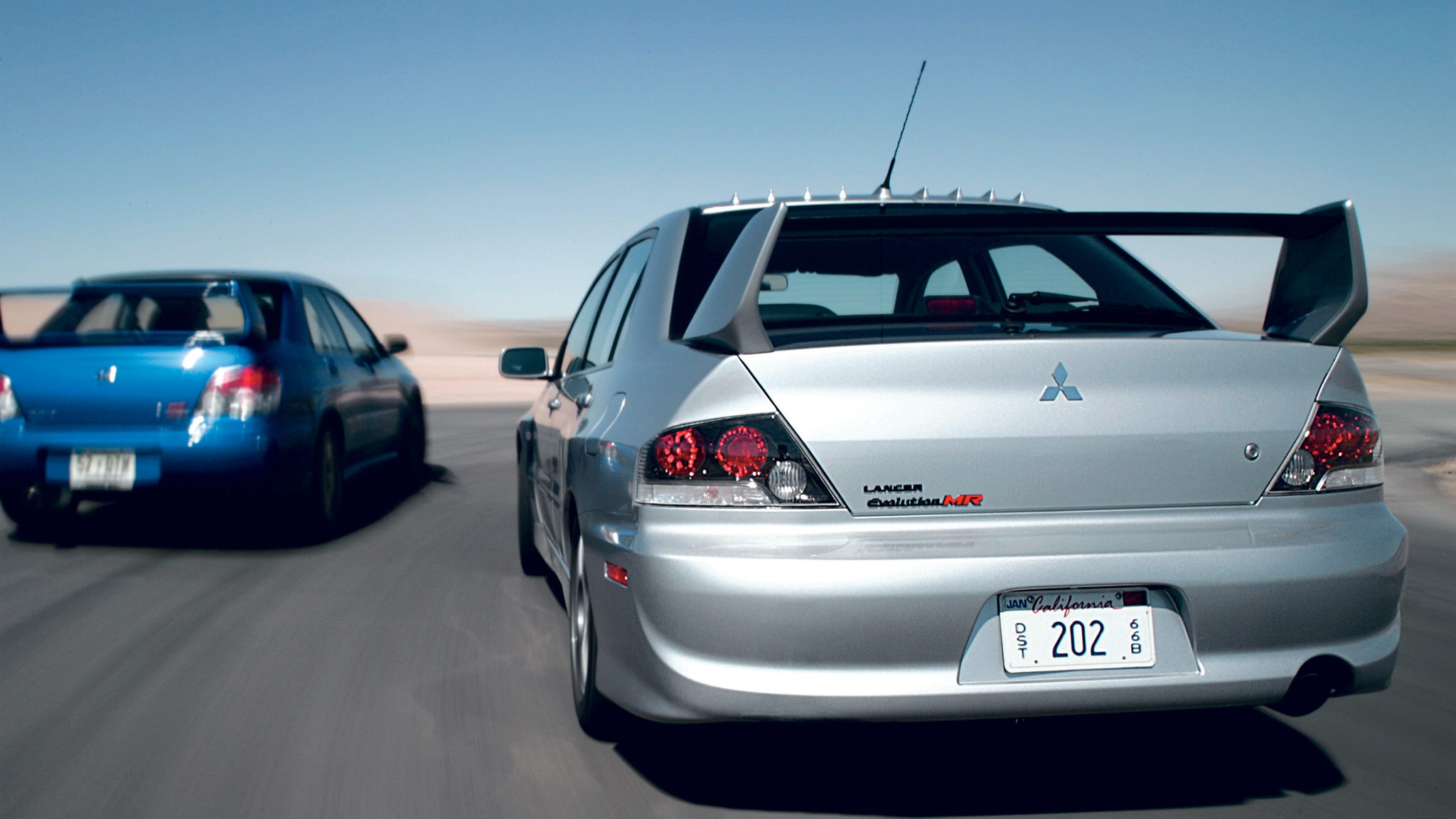
[This story first appeared in the December 2005 issue of MotorTrend] Our mission: Wring out these two rally-bred machines at the dragstrip, on the handling course, and at the racetrack, and pick a winner–a dream assignment if these two cars weren’t so damned evenly matched.
If you’re one of those who skips to the spec chart to see who won, let’s save you the paper cuts. You’ll find the following differences: 0.0 second to 60 mph, 0.3 second to 100 mph; 0.3 second and 0.1 mph at the quarter mile, 1.0 mph in the slalom, 0.01 g on the skidpad, and 0.39 second a lap on the racetrack. There. Go ahead. Pick a winner.
It’s clear the Mitsubishi Lancer Evolution IX MR and Subaru Impreza WRX STI (that’s now a capital “I” for 2006) are optimized to the same formula specified by the WRC rally racing series in which they participate. Almost. The U.S. version of Subaru STI deviates from the maximum 2.0-liter rule by adding a half-liter of engine displacement. Of course, the racing versions of both are tuned, lightened, and upgraded within the rules to withstand the rigors of racing in a wide variety of environments. Other than that, what’s built into the foundations of these street cars (especially bodywork above the bumpers) is what’s required on the race cars.

For those keeping track, here’s a short list of mechanical changes since this duo was last featured in “Hatfields and McCoys” (October 2004). The Evolution MR has gained variable timing (MIVEC) on its intake valves, producing a more generous throttle response at a lower rpm–and it’s readily apparent from 3500 rpm and up. The difference isn’t as easy as looking at a 2005 versus 2006 MR dyno chart, which shows only marginal changes to the curve.
Combined with a revised, freer-flowing turbo housing and new exhaust system, horsepower has increased to 286. Incidentally, that new exhaust system sounds much better. The previous Evo sounded like a vacuum that’s sucked up a sock. The new one has a much throatier rasp akin to a dog expelling kibble. Adding MIVEC meant revising the cylinder-head casting and gasket. The new casting, along with longer-threaded spark plugs, better resists heat. Stronger alloy pistons and new rings are said to reduce oil consumption by about 10 percent. There’s also a new bell housing cover designed to reduce interior noise.

To feed the higher-output motor, the fuel pump is able to deliver a seven-percent-capacity increase over the previous one. Shifting six gears got easier and more precise due to Teflon-lined shift cables and a better shift-stroke stopper. The clutch has received a wide-angle damper to quell vibration noise. Aerodynamically, there are subtle revisions. A new front fascia resulted in the deletion of the triangular grille splitter and more cooling for the intercooler below. The carbon-fiber rear wing is now hollow to reduce upper body weight, and the uprights that support it are body colored. Dealer-installed options (neither of which was on our tester) include a front air-dam extender and a rear-wing wicker bill that claim to reduce lift and drag. Rooftop vortex generators remain standard but are now body colored.
In the Subaru camp, mechanical changes are fewer and less evident. The open planetary center differential is now controlled electromechanically, and its default front/rear distribution ratio has been changed from 35:65 to 41:59. A torque-sensing mechanical limited-slip device replaces the previously hydraulically controlled unit to speed reaction of the torque distribution. The Tribeca’s steering-angle sensor has been added to the array of electronics that direct the operation of the STI’s center differential. In manual mode, the diff can still be progressively locked in any of six positions up to a 50/50 distribution. Carbon-reinforced synchronizers smooth shifts into forth, fifth, and sixth gears.

Aero tweaks come at the expense of looks–or is that vice versa? The new airplane-inspired front fascia is said to be slipperier and more efficient, which allowed a smaller hood scoop to be fitted. A new STI-specific roof vane spoiler borrows the Evo MR trick of pulling the airflow down against the rear glass to allow clean air to act on the rear wing, thus increasing its effect. No word on how much extra downforce is made, but we assume it’s up from the previous 2005 STi’s 50 pounds at 100 mph. Tucked under the rear bumper, the new diffuser actually helped us vacuum our slalom course, producing a dusty roostertail as it flew past.
Have all the hours Mitsubishi and Subaru engineers spent tweaking and fiddling with these cars made a difference?
Not really.
Racing teams will appreciate the help where WRC Championship points are won and lost within tenths of a second. In the real world, however, both the MR and the STI are still supremely capable and entertaining and only fractionally more so this time around. We’d still bet money on either one against a Lamborghini or Ferrari on the right track. Yes, those hard-core Evo or STI fans who spend hours in their respective online forums might feel a nuance here and there, but neither one has leapfrogged the other. In fact, the Evo and STI perform closer than ever before.
Overlaying this year’s best lap onto last year’s, the 2006 Evo MR’s lap time improved by 0.63 second. The gain appears to come from that 10-horse increase over last year’s. The graph of each of the acceleration zones shows a slightly steeper incline with the 2006 MR. The new car’s top speed on the back straight increased to 99.6 mph, where the old MR achieved 96.9 mph. Analyzing the lateral and braking g-loads each car produced is an exercise in subtlety. A node here and a blip there differentiate old from new, but all in, they’re indistinguishable from one another.
Last year, our early build-2005 STi tester felt slow compared with other examples previously tested. With over 1600 miles on this year’s STI, it had been broken in properly and produced all the power it should. As a result, the lap time, comparing last year’s to this, improved to a greater degree compared with the two Evos. The speed trace for nearly the entire lap for the 2006 STI is higher than last year’s car.
The result is a 1.6-second-quicker lap time and a 2.8-mph-higher top speed. The improvement in corner exit speeds, where the new center differential may have shown an advantage, couldn’t be measured. Last year’s car was more apt to rotate into a tail-out counter-steering slide. This year, though that technique is still possible, it requires more effort and commitment to make it happen. The former STi trait of nosing into a corner when the throttle is lifted (and drifting out when the gas pedal is mashed) seems to have gone away with the old center diff. Too bad, because it was one of the things to point to as a divergent trait between Evo and STi. The new STI is just a hair more neutral than its predecessor. As with the Evos, the STi versus STI g-loads are only slightly different and can’t be viewed as conclusively better or worse.
Only after combining the best laps of the 2006 Evo and 2006 STI do marked differences become evident. Analysis shows the Subaru slightly more “chuckable” than the Mitsubishi, exhibiting a number of higher g-load spikes than the Evo, which shows smoother curves. This is further supported by a particular set of esses where the STI enters at a higher speed and spikes the g-load prior to the exit. The driver reported more confidence throwing the STI because he knew it would reward him with a lurid slide.