Ezra Scattergood knew a thing or two about high voltage. Known as Los Angeles’s “father of power,” Scattergood led L.A. ‘s Department of Water and Power for 31 years, growing it from a one-employee institute into the largest municipal utility of its kind. Under Scattergood’s reign, the City of Angels exploded into one of the most influential and vital metropolitan areas in the world. As Cosmopolitan magazine wrote in 1947, “Probably nobody has contributed more to the creation of this phenomenal Western metropolis than Ezra Frederick Scattergood.” Knowledge may be power, but knowledge of power can be just as, um, powerful.
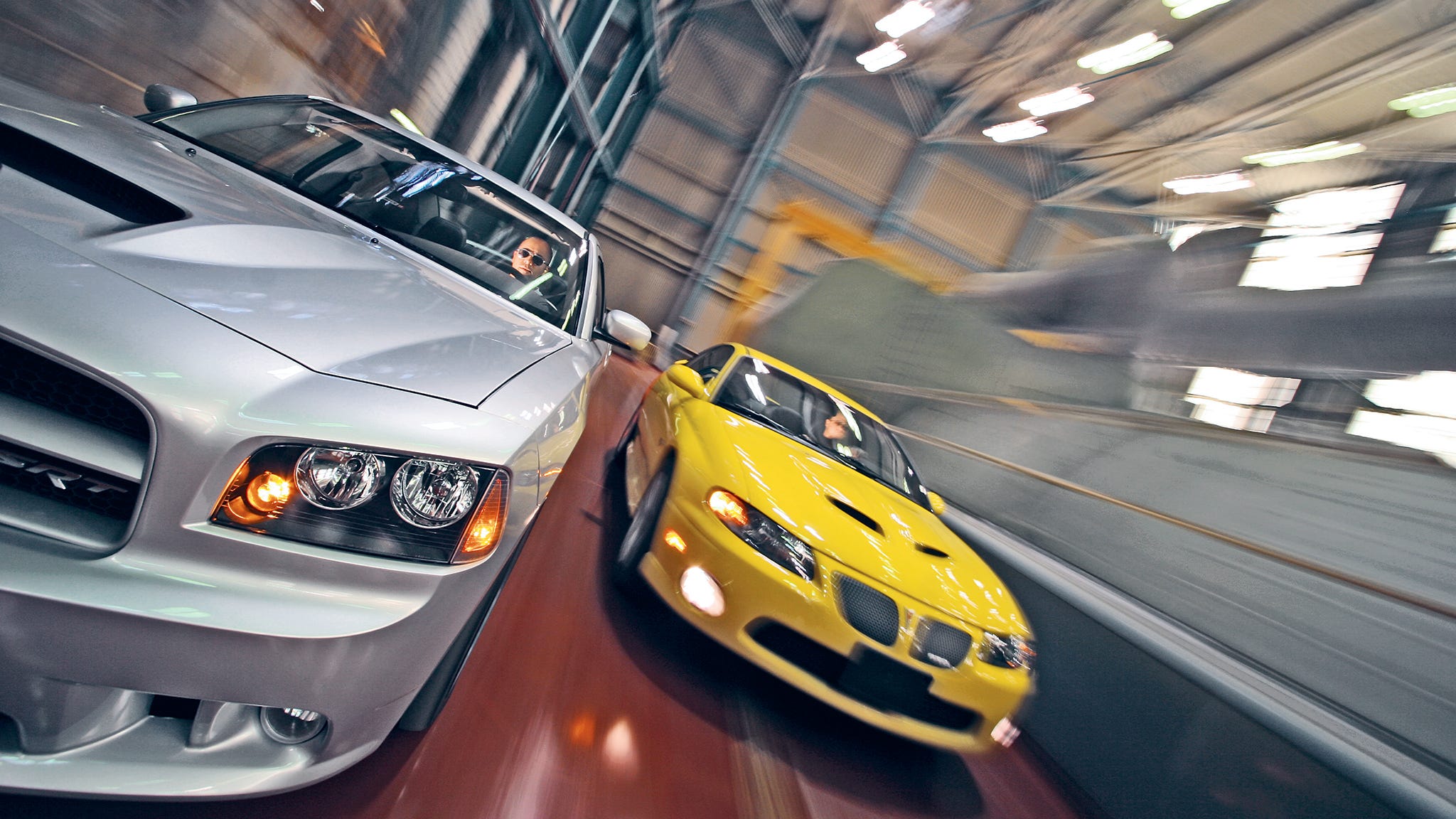
Seeing we possess an endless knowledge of power–horsepower, that is–we thought it only fitting to bring the burly, all-new Dodge Charger SRT8 and its archrival, the Pontiac GTO, together for a rendezvous of force at nearby Scattergood Generating Station in Playa Del Rey. For four decades, these two nemeses have not only been giving the automotive world lessons in power, they’ve also been duking it out, toe to toe, with many a face-off going down right in Scattergood’s backyard of SoCal. Consider our little soiree an homage to good ol’ Ezra.

The rules were simple and the stakes high: Bring your most potent ponycar to the party, leave all excuses at the door, and fight for the right to be crowned king musclecar. The General versus the Goat in the ring at Scattergood’s house. Let the power trip begin…
Although the Charger SRT8 is the fresh face in this fight, we’ve seen its formula before. Under its four-door “coupe” styling, replete with flying-buttress C-pillars echoing its 1960s ancestors, the new Charger is for all intents and purposes a Chrysler 300 SRT8, sharing its platform, powertrain, chassis, and numerous dimensions. But while the two appear nearly identical in size, the Charger’s bodywork has been pumped to add 3.3 inches of length, 0.4 inch more width, and 0.3 inch extra height.
That the musclecar maniacs in DaimlerChrysler’s Street and Racing Technology (SRT) group subjected the Charger to essentially the same rigorous workout as the 300C SRT8 means the testosterone-infused Dodge leaves the gym emphatically ripped compared with its softer, 5.7-liter sibling. Accordingly, it packs a 6.1-liter, 425-horsepower Hemi V-8; a heavy-duty five-speed AutoStick teamed with upgraded axles and differential; SRT-tuned dampers, springs, bushings, and anti-roll bars; a half-inch-lower ride height; and four-piston Brembo brakes peeking through 20-inch forged wheels wrapped in Goodyear summer tires. Appropriately, the Charger gets a more menacing face that features an integrated hood scoop, a body-color cross-hair grille, and a deeper air dam with brake ducts the size of cantaloupes. See a Charger SRT8 loom large in your rearview mirror, and it looks like you’re about to be run down by an angry, hungry lion.

Speaking of animals, how about the Charger’s bait in this shootout, the Goat? Now in its third year, the GTO enters 2006 with just one significant change–available 18-inch wheels. Unfortunately, the timing of our test dictated that Pontiac could only lend us a 2005 for evaluation. Nonetheless, we forged ahead with the not-as-fresh Goat, especially since it still boasted the necessary attributes to meet the Charger head on: a 6.0-liter, 400-horsepower LS2 V-8 pulled from the C6 Corvette; an optional Tremec six-speed manual transmission; four-wheel independent suspension; a limited-slip differential; and variable-ratio power steering. This Goat can go, but is it quick enough to beat the Charger?

Objectively, yes. The GTO outgunned the SRT8 from 0 to 60 (4.7 seconds versus 5.0), 0 to 100 (11.7 versus 11.9), and in the quarter mile (13.3 seconds at 105.9 mph versus 13.5 at 106.3). Chalk it up to a better weight-to-power ratio (9.4 pounds/horsepower versus 10.0) and, at least for the 0-to-60 blast, the advantage of launching with a manual transmission. Subjectively, however, the advantage didn’t register on the seat-of-the-pants meter, a sensation backed up by the closeness of the numbers. If anything, driving the two back to back leaves the impression that the Charger is the friskier beast, its Mercedes-sourced five-speed automatic unleashing the Hemi’s 425 ponies so fluidly that stomping the throttle delivers a seamless rush of acceleration that could easily double as mental therapy. Moreover, the Charger emits an intoxicating, raspy rumble befitting its size and strength, while the GTO sounds friendlier, as if comparing a Rottweiler’s growl to a bloodhound’s. Perhaps it’s the GTO’s way of signaling that it has a tighter rein on its 400 horses, due in large part to the balky, long-throw Tremec shifter that makes harnessing all that horsepower a chore. Like an omelet pan, the six-speed needs to get intimate with Teflon.