The Ferrari Roma was a breath of fresh air. Before it showed up in 2019 as a 2020 model, Ferrari design had gotten overly aggressive. Think about the 488, the F8 Tributo, and the 812 Superfast. All are wild, snarling things that look right at home in Miami, but they arguably lack the elegance more appropriate for a night out in Milan. Enter the Roma, a butch, handsome, almost formal front-engine sports car—a Ferrari in a tuxedo. Fast-forward six years, and Ferrari now gives us the 2027 Amalfi, the Roma’s replacement. The people in Maranello would like you to think of it as the Roma with its bow tie loosened, shoes off, standing in the Mediterranean while sipping on a spritz. A more fun, more relaxed, more colorful Roma, in other words. Is that the case, or is the Amalfi something else entirely?
New Suit
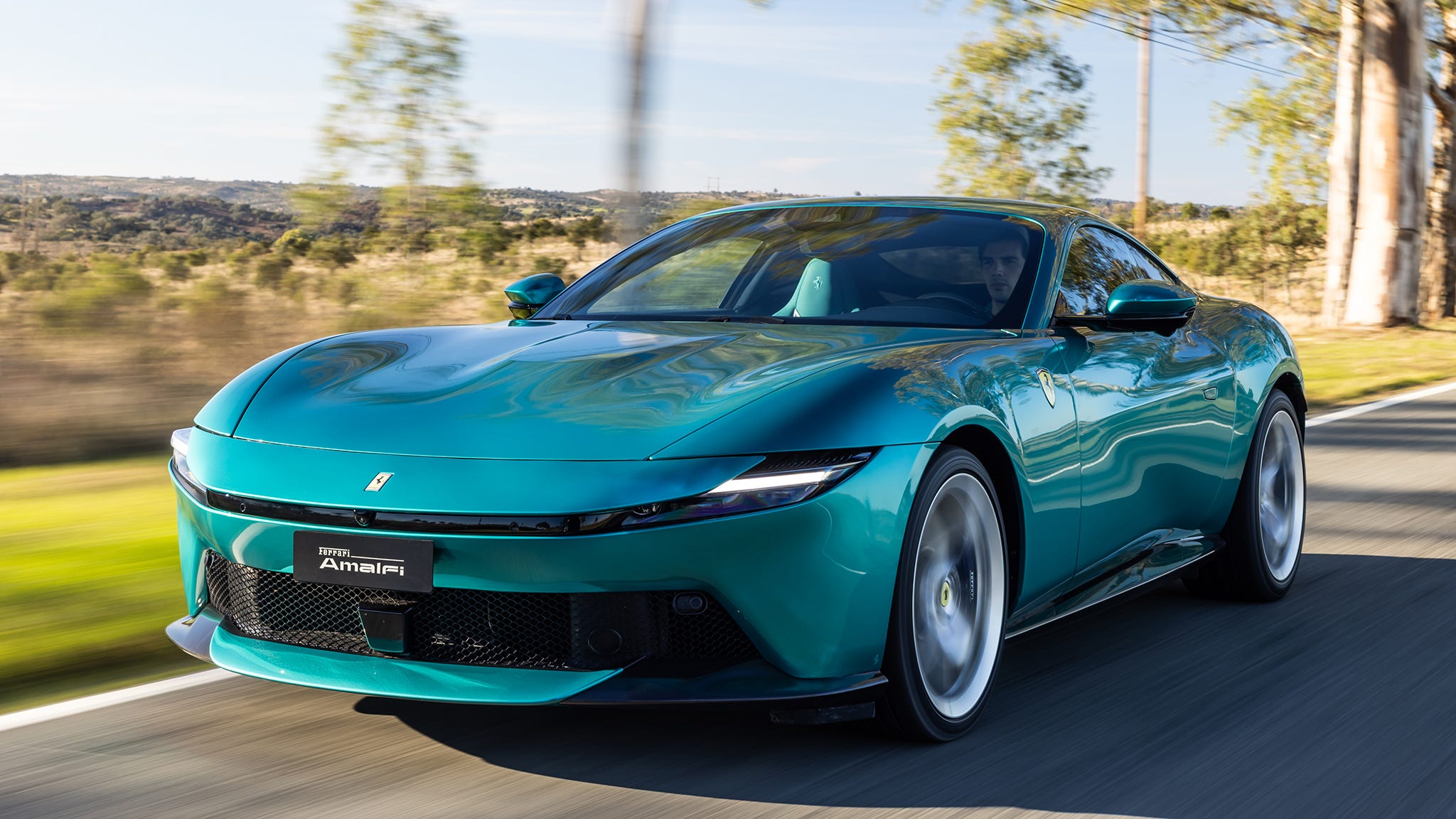
Assuming you don’t live under a rock, you’re probably aware Ferrari design has become quite bold, if not challenging, as of late. The Roma was a straight-up knockout in terms of looks (says us), but it didn’t look like any other modern Ferrari. With the Amalfi, however, you can see the family resemblance to the rest of the stable: the Purosangue, 12Cilindri, new 849 Testarossa, and F80. That said, it’s more of a cousin than a sibling to those cars. Ferrari’s design team explained that it began the Amalfi project with a solid, pure shape. A Platonic ideal of a GT if you will. Every cut into this pure form was painful to the designers’ eyes—headlights, door handles, and wheel openings were all considered bad. To mitigate this pain, the team placed as many features as possible within the black stripes running across the car’s front and the rear. That means the headlights and front camera are hidden by the black groove, and the same goes for the taillights, rear camera, and hatch release. Also hidden up front, though this time in a metal-mesh lower grille, is the forward-facing radar and parking sensors. This last part is the single best visual improvement over the Roma. The Roma and the Amalfi are different enough that it’s difficult to say one looks better or worse than the other.

The 2027 Ferrari Amalfi’s aerodynamics are much improved over the Roma’s. The biggest change is that the active rear wing is now deployable in three positions instead of two. In the lower position, it’s flush with the body. The middle position raises it by 20 degrees. When fully deployed at 50 degrees, the wing generates 242 pounds of downforce at 155 mph. That’s a long way from, say, an F1 car but not bad for a luxury GT model. That final wing position also increases the overall drag by 4 percent, enough for it to function as an airbrake. Moving to the Amalfi’s front end, cooling vents above the headlights feed various radiators. Along with twin underbody vortex generators (like the Roma used) that help with downforce, two additional venturis shoot cooling air at the front brakes.
Internalized Complaints
Look, we’ve always been Roma fans. In terms of looks, “Stunning is the best word to describe the Roma’s exterior,” we once wrote. In terms of how it drove, we had almost nothing but praise. We like it for being a split-personality GT/sports car, and one that errs on the side of “yeeha!” Our only notable gripe concerned all the touch controls on the steering wheel and dashboard, including the Start button and the extra-finicky mirror controls. It turns out we weren’t alone, as Ferrari admits all the haptic stuff was the No. 1 customer complaint—especially the virtual Start button. Well, guess what? Physical buttons are back. There’s a big old red Start button on the wheel, just like almost all Ferraris have had since the F430. The mirror controls are, sadly, carryover items, but in truth, how often do you adjust those?

Ferrari treated the entire cabin to a needed and thorough makeover. The other big change is to the 10.6-inch central touchscreen, which it rotated 90 degrees from portrait layout to landscape. It’s also been lowered below a central cut line, one that mimics the exterior’s black grooves, deemphasizing the screen along the way, as all non-essential controls (massaging seats, for example) are found there. The passenger screen remains; it’s a trend we continue to question. (Don’t Ferrari passengers own phones?) Speaking of your passenger, they are now separated from the driver by a lovely piece of milled and anodized aluminum.
Mechanical Changes
We’ll start with the new Amalfi’s heart, a 3.9-liter flat-plane-crank twin-turbo V-8 that now produces 631 horsepower, 19 more hp than the Roma. Torque remains the same at a healthy 561 lb-ft. Notably, the redline is raised by 100 rpm to 7,600, and the engine revs much more freely thanks to a couple of changes. Both the Roma and the Amalfi make peak torque from 3,000 to 5,750 rpm, but the Amalfi gets to 3,000 quicker. These changes include an engine controller based on the one in the mid-engine 296, equal-length exhaust runners, and revised turbochargers that now spin up to 171,000 rpm.

We were sadly never able to strap our test gear on a Roma, but Ferrari claims the Amalfi will hit 62 mph 0.1 second quicker—in 3.3 seconds—and will hit 124 mph in 9.0 seconds. Due to increasing noise restrictions found around the globe, the Amalfi’s exhaust is a bit quieter than the Roma’s from outside the vehicle, though Ferrari has worked to ensure plenty of appropriate vroom noises penetrate the cabin. Despite the turbos, the V-8 sounds healthy enough to our ears. While quieter than before, it’s not too quiet.
The big Brembo brakes are now activated by wire, the same system found on the 296 GT3 EVO race car. Ferrari’s ever-evolving Side Slip Control (SSC) is updated to version 6.1, and it controls the amount of yaw and wheelspin that’s allowed to occur before the nannies activate. The Amalfi also features a “Dynamic Enhancer,” which you can just think of as drift controller. The MagneRide dampers are revised for better comfort when you want it and more sport when you don’t. Finally, the Amalfi rides on new tires, Goodyear Eagle F1 Supersports, 245/35R20 front, 285/35R20 rear.