It’s fair to say VinFast expected to make a better first impression among Americans than it did with the VF8. Designed by Pininfarina, the compact electric SUV was engineered with global talent, software-defined features, advanced driving aids, and positioned as VinFast’s first salvo into the incredibly competitive—and lucrative—American market.
It’s also fair to say VinFast hoped for better than the verdict we rendered after our 2023 First Drive: “The VF8, as it sits, is not ready for public consumption.” Plagued by software errors and powertrain refinements issues, we suspected that “once word of these problems gets around, either from reviews like this one or owners or both, it’s going to savage the company’s reputation.”
Unfortunately for VinFast, we were correct.
Yet the company, founded by an entrepreneurial Vietnamese noodle peddler turned billionaire, hasn’t appeared to have backed down from the challenge. While its public relations arm has gone largely dark, its promised North Carolina factory unfunded, and its direct-to-customer business model switched to the conventional franchisee model most automakers use, it’s also quietly launched its second vehicle stateside, the VinFast VF9, a new electric three-row SUV.

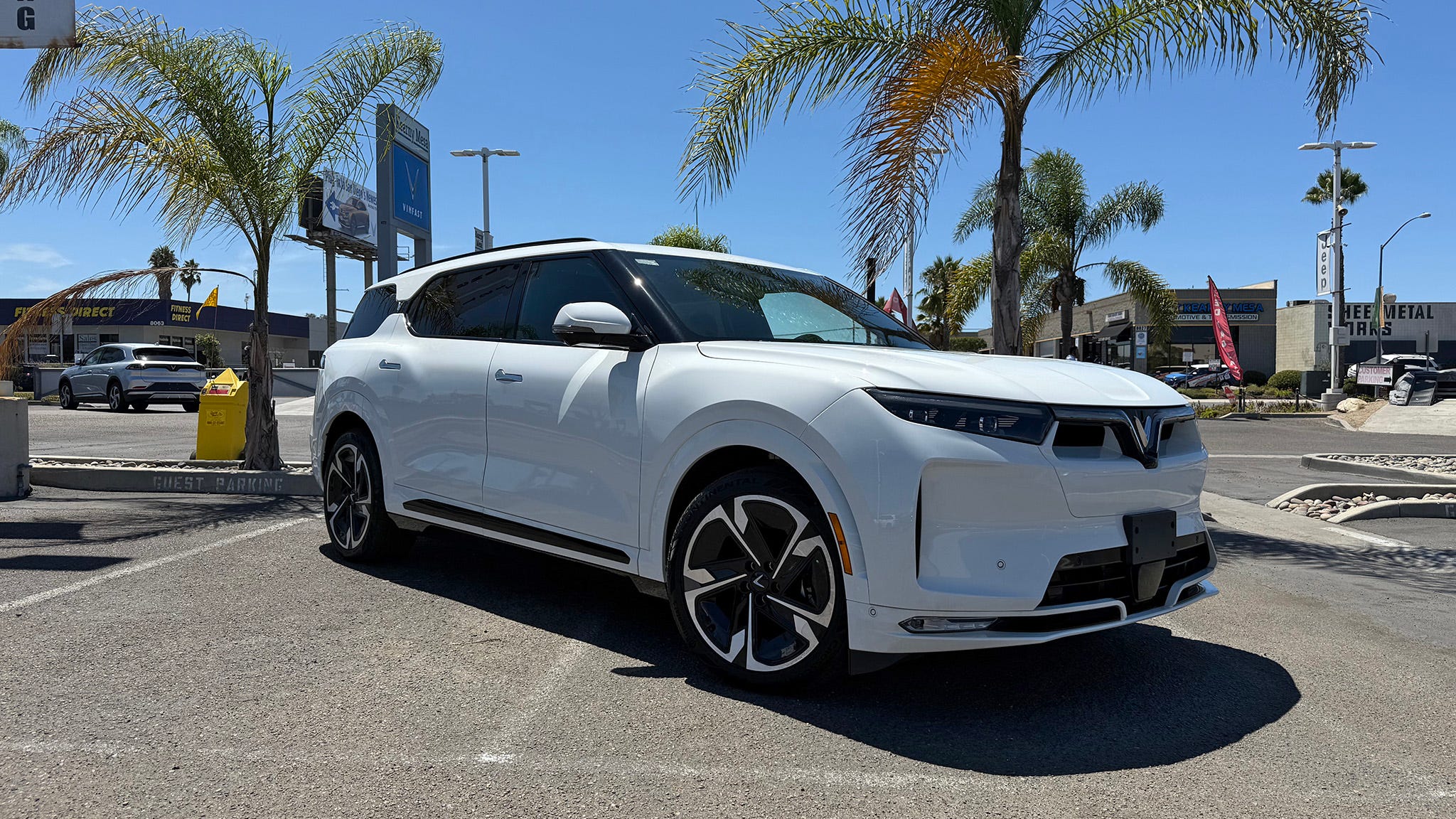
We were curious about the model, so we soon found ourselves standing in front of one at the company’s sole remaining West Coast outpost, an independently owned dealership in San Diego. With keys in hand and an eager salesperson at our side, it was time to find out how much truth there is to the old adage, “If you hit rock bottom, the only way to go is up.”
What’s the VF9? How Is It Different Than the VF8?
Launched for the 2024 model year but just now hitting American shores in real numbers, the VF9 is the full-size three-row complement to the compact VF8, which is about 14.4 inches shorter and 2.6 inches narrower. The VF9 is about the same size as rival EV three-rows from established brands, such as the Hyundai Ioniq 9 or Kia EV9. It’s powered by the same motors as higher-end VF8s, a permanent-magnet unit at each axle that delivers a combined 402 hp and 458 lb-ft of torque and all-wheel drive. It sports a large, 123-kWh lithium-ion battery pack that’s rated for up to 287 miles of range in the VF9 Plus. (The federal database reveals there was once a VF9 Eco rated for 330 miles of range, but all reference to it has been scrubbed from VinFast’s American website, and none were on the dealer’s lot. We assume plans to offer it were scrapped.)
According to the appreciably knowledgeable salesperson—a welcome change versus our last experiences with VinFast’s consumer arm—the VF9 Plus has a 400-volt electrical system, is capable of fast charging with CCS chargers at rates up to 150 kW, and can charge overnight on a home outlet at rates up to 11.5 kW. It is incompatible with NACS-style chargers.

Prices for the VF9 start at $64,100, though as our salesperson notes, you can’t actually buy a VF9 yet—they’re available for lease only, for $449 per month for a two-year lease at 10,000 miles per year.
First Impressions
Like the VF8, the VF9 was designed by Pininfarina and sports a conventionally attractive, muscular form that stands out in the bright Southern California sun, especially in the forest green or red. (White, like the car we drove, is less flattering). Fit and finish won’t make any German or Japanese automaker sweat but is better than some things we’ve seen from companies like Tesla or Stellantis of late.

Inside the VF9, a large 15.6-inch touchscreen is the focal point of the cabin, while a large center console splits the front seats. A push-button transmission takes up most of the real estate closest to the driver, and shared cupholders, wireless phone chargers, and infotainment controls take up the rest of the space. The VF9 comes standard with seven seats in a conventional 2-3-2 arrangement, but six seats with second-row captain’s chairs and a large console for second-row occupants is available for $1,250.
The front bucket seats are big, thronelike, and comfortable—almost as if they came out of an American full-size pickup. The faux leather they’re wrapped in is convincing enough, and they feature heating, cooling, and a massage function. Jump back into the second row of our six-passenger test car, and you’ll find VinFast has simply used the front seats as its captain’s chairs, providing a comfortable and commanding perch from which to enjoy the surprisingly spacious and well-equipped second row.