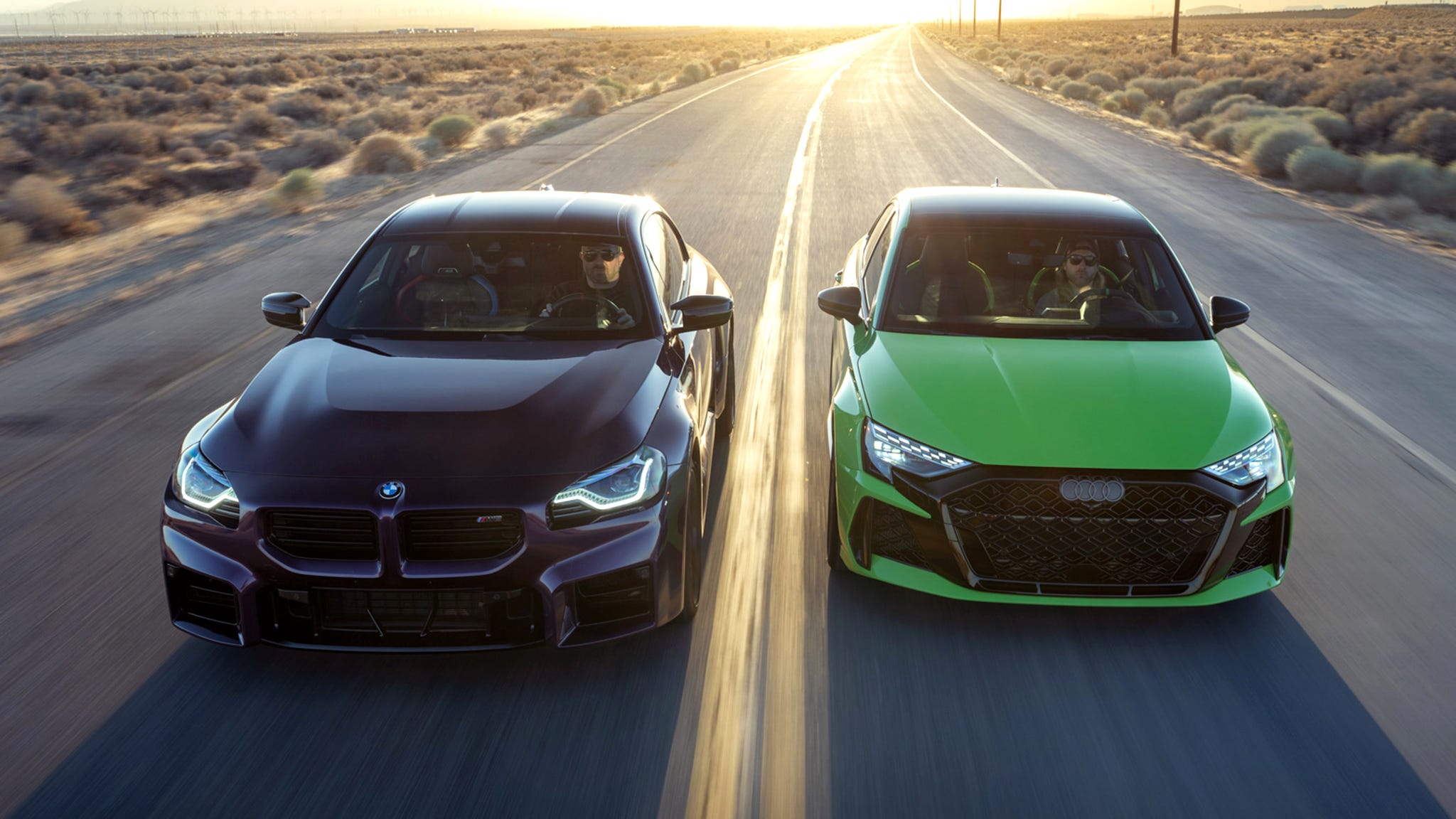
Hear us out. We know the 2025 Audi RS3 and 2025 BMW M2 are very different cars. The BMW is a coupe, the Audi a sedan. The BMW is rear-wheel drive, the Audi all-wheel drive with a transverse-mounted engine. The BMW has a manual transmission, the Audi a dual-clutch automatic. The BMW has six cylinders, the Audi five. What are we even doing here? Like German sausage, they have a lot more in common than you might realize.
How the Sausage is Made
Obviously, both are German. Both Bavarian, even. Each is a compact, two-row sports car, regardless of how you get to the back seats. They’re priced within $5,000 of each other to start and within $4,000 of each other as tested. Both are fresh off a minor midcycle update. They’re also, as we’ll see, nearly identical in terms of performance. Yes, they look and drive differently, but they’re simply two different means of achieving the same result.
The RS3 gets the bigger update of the two by a small margin: new front and rear bumpers, a new squared-off steering wheel, an optional RS Sport Exhaust, and a faster powertrain control module, which allows for finer control of the torque-vectoring, twin-clutch rear axle. Power remains the same at 394 hp and 369 lb-ft.
The M2’s updates are even harder to spot but equally noteworthy. A 20-horsepower increase finally puts it on par with the larger, heavier M3 and M4. Automatic transmission models also get a 37-lb-ft boost in torque. All told, it now makes 473 hp and either 406 (with the manual transmission) or 443 lb-ft. It, too, gets a new steering wheel (fully round), along with a new curved widescreen display running the latest iDrive 8.5 software, a sharper head-up display, and a remapped throttle pedal. Oh, and now you can get it in wild colors like Twilight Purple Pearl Metallic.

Different Recipes, Similar Results
We’re not kidding about the performance. Despite their wildly different powertrains, the RS3 and M2 are right on top of each other in our instrumented testing. The Audi is slightly better in a straight line, the BMW better in corners.
The Audi, with its all-wheel-drive launch and hyper-responsive dual-clutch gearbox, is quicker in a straight line. The BMW has more power, and despite weighing more with a better weight-to-power ratio, it can’t overcome the Audi’s superior launch and faster shifts. That said, you can get an M2 with an eight-speed automatic, and were you to do so, it would negate the RS3’s advantage. The last M2 automatic we tested (a 2023) was dead even with the Audi at 3.5 seconds to 60 mph and 0.3 second quicker through the quarter mile, and it had less power and torque than the new model.
Stopping, though, is the Audi’s domain. Massive carbon-ceramic brakes up front and at least the third performance tire we’ve tested on an RS3 in as many years returned a clear-winner 98-foot stop from 60 mph. This M2 needed an extra 3 feet, and the closest we’ve seen one come to the Audi still took an extra 2 feet.
Put ’em in a corner, though, and the BMW surges ahead. A teensy bit higher lateral g in steady-state cornering on the skidpad quickly turns into a figure-eight lap time that’s 0.3 second better than the Audi. Part of this is grip, but it also illustrates how much more powerful the BMW is. The RS3 pulls hard, but the BMW pulls harder, especially from a roll. Like we said, the Audi’s straight-line advantage is in the launch.

What’s Your Favorite Kind of Sausage?
The differentiator that matters is how they drive. They may deliver nearly the same performance, but they go about it quite differently.
The RS3 is the more straitlaced of the two. Its trick differential does masterful work of making the car feel like it has a rear-biased all-wheel drive when the rear torque distribution maxes out at 50 percent. There’s a hint of 2009 Nissan GT-R in how the RS3 puts its power down exiting corners, which is more than enough to invalidate any arguments about engine placement and orientation. The way adding power pulls the nose out of a corner rather than pushing it wide is found in precious few cars.
The BMW, by contrast, is old school. It’s on you to make the grip work with the rear-drive power. Done correctly, you can induce a perfect rotation on the way out of every corner with the right application of power. The front end has more than enough grip, so you’re in more danger of overdoing the rotation than pushing the nose out. Neither car will squeal its tires on a public road without truly reckless driving, but the BMW floods your brain with a bigger dopamine hit you nail a corner.

It’s more work, though, and we’re not just talking about the manual transmission. The BMW’s steering feels jittery and high-strung at times until you adapt to it. Slow hands are the order of the day. Your inputs have to be very small, precise, and immediate. It’s super easy to overdo it, but once you get a feel for it, the M2 comes alive.
The throttle and brake pedals are similarly sensitive and require the same careful modulation. You have options with the power, though. Leave it a gear high, and you can use the prodigious turbo lag to your advantage, getting on the throttle right at the apex knowing you’ll have the steering wheel nearly straight when the turbo hits. Or drop a gear and use the top-end power to rotate the car on the way out. Dealer’s choice.
All that sensitivity to inputs is exacerbated on rough roads. The Audi, meanwhile, is rock solid. It’s not fazed by anything. It’s so hooked up, in fact, it can feel like it isn’t even trying. The transmission is perfect on its own, so you can drop the mental load of choosing gears and just work the brakes and steering. Any racing driver will tell you less work behind the wheel is a good thing. (Of course, you could get the M2 with the automatic and make the same argument, and we deeply appreciate that BMW still gives us the choice.)
Yes, the RS3 is confident, mature, and supremely well mannered by comparison, but the effort it takes to drive the BMW right pays out substantially better. The Audi does everything right, but like a toxic relationship, we find ourselves crawling back to the M2 looking for another rush. No small part of that is outright horsepower, because while the Audi takes off like a rocket from a roll, the BMW takes off like a rocket in a slingshot. It’s addicting, and it’s part of the reason the BMW drains its tank 50 percent quicker.