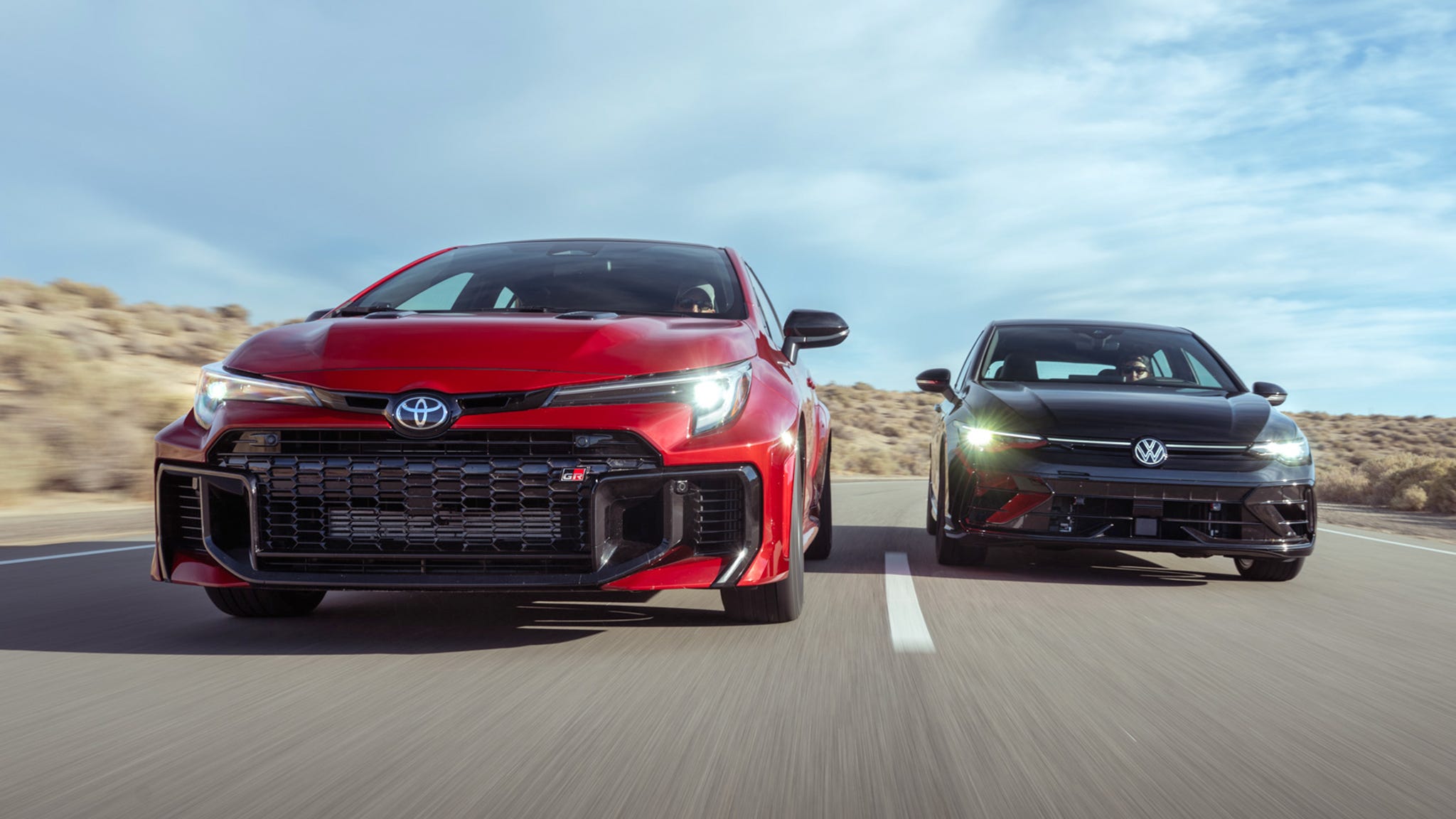
Some say the hot hatch segment is dying, but nothing will make you feel more alive than taking a fast drive on a curvy road in the Toyota GR Corolla or the Volkswagen Golf R. Both cars storm into 2025 with more power and a host of other useful improvements, including a newly optional automatic transmission for the Toyota. We count these all-wheel-drive, turbocharged terrors among our favorite thrill rides, but which is better? Sit down, strap in, shut up, and hang on as we attack the twisties and figure out whether the GR Corolla or the Golf R delivers the most delight for your dollar.
Meet the Challengers: Corolla’s Lightning vs. VW’s Thunder
The GR Corolla sped straight into our hearts when it made its debut for the 2023 model year, and in fact our own Jonny Lieberman—EV fanatic, Corolla hater—was so taken that he bought one for himself. In the unlikely event you’re unfamiliar, the critical thing to know about the GR is it has as much in common with a regular Corolla as lightning does with a lightning bug. Its 1.6-liter turbocharged three-cylinder engine delivers 300 horsepower (185 ponies per liter!) to all four wheels, and for 2025 this mighty mite gets a 22-lb-ft bump to match the Golf R’s 295 lb-ft of torque, plus a new eight-speed automatic transmission. (Don’t worry, purists, the six-speed stick is still available.) A new top-of-the-line Premium Plus model adds a carbon-fiber roof panel, hood vents, matte black wheels, and a powertrain cooling package. Base price for the basic six-speed car is $39,995, and our automatic Premium Plus test car, with options such as a chassis brace and floormats (Really? We’re still paying extra for those?) stickered for $50,144.

The Golf R is the old hand, having been part of Volkswagen’s U.S. lineup off and on since 2012. For 2025, it too gets a power bump, from 315 to 328 hp, with no change in torque. Unfortunately, the manual transmission has been dropped, leaving a seven-speed dual-clutch automatic as the only choice. The front fascia is new, as is the Black Edition shown here, with (surprise, surprise) blacked-out trim inside and out. The new $3,795 Euro Style package adds an Akrapovič titanium axle-back exhaust system and blue seat trim while deleting the sunroof, front seat ventilation and memory, and all power seat adjustments save the backrest. Why pay more for less stuff? Because the package shaves 80 pounds from the curb weight, which VW seems to think is worth some dough. Pricing starts at $48,325, and our Black Edition, Euro Style–equipped (perhaps we should say de-equipped?) model listed for $53,731.
Hot Hatch Couture: Streetwear or Suit?
The Toyota GR Corolla wins the Eyeball 500 with its widebody-kit styling, more scoops than the TMZ home page, and three exhaust tips poking out from the rear bumper—a cheeky reminder of the number of cylinders lurking under the hood. It makes the Golf R’s styling seem rather dull, and VW doesn’t help by only offering the R in blue or black paint. That said, the GR Corolla’s palette isn’t much wider, offering only black, white, gray, or red, with an extra charge for the latter two.

But the VW looks better on the inside, where the Black Edition’s carbon-fiber dash trim and the Euro Style blue-accented seats are a step up from the bland plastics of the Toyota’s rather stock-looking Corolla interior. The Golf R’s front seats, heavily bolstered like the Toyota’s, are a little more generous for those of us who like our burgers with extra cheese, and the VW offers more back-seat and trunk space, as well. We’re not fans of the infotainment system of either car, and we were also surprised that for 50 grand neither car gave us nice-to-haves like a bird’s-eye parking camera or power seat adjustment (and to think, VW charges extra not to have power seats!). Luckily for both competitors, this comparison focused on dynamics rather than amenities.
GR vs. Golf R, By the Numbers
While we were looking to find which car generates the most grins, we also wanted to get some baseline numbers, so off to the test track we went. We’ve tested several GR Corollas and have struggled to match Toyota’s claimed five-second flat 0–60 time, but the automatic GR came the closest at 5.1 seconds, 0.3 second quicker than the last two manual cars we tested (both 2023s with the lower torque rating). To get it to 100 mph took 12.3 seconds, 1.1 seconds quicker than the ’23 six-speed GR Corolla, and the automatic car took down the quarter mile in 13.6.
The Golf R was in a different class, blasting to 60 in 4.1 seconds, hitting 100 in 10.2, and crossing the quarter in 12.6. But the GR Corolla needed just 101 feet to stop from 60 mph, 10 feet shorter than the VW’s best stop. The Toyota, wearing Michelin Pilot Sport 4 tires, pulled 0.95 average g on the skidpad, while the Bridgestone Potenza S005-shod Golf R did 0.92. Pluses and minuses added up on our figure-eight handling course, which the GR Corolla circled in 25.1 seconds, just one tick behind the Golf R’s 25.0.
Bottom line: The Golf goes quicker, the Corolla grips better, and the result is two cars that are rather evenly matched. But we’ve driven slow, ill-handling cars that delighted us and race-ready rides that bored us to tears, so it was time to head out to some of our favorite curvy roads and do a little thrill-seeking.

Heart on Sleeve vs. Ace Up Its Sleeve
If the Corolla’s engine only gets a B for acceleration, it gets an A+++ for effort. The three-banger has an aggressive, angry growl and it pulls as if Ted Lasso is under the hood cheering it on. Ultimately, though, the Toyota suffers from its lack of power. Passing slower traffic on a two-lane—and in either of these cars, all traffic is slower traffic—was a breeze in the Golf but a white-knuckler in the Toyota.
Does GR Corolla’s new automatic stifle the fun? Only if you let it. Left to its own devices, it’s quick to upshift and drop the revs, even in Sport mode (once a Toyota, always a Toyota). Punch the gas, and there’s windup before the fastball pitch, which is thrilling but not always beneficial to smooth progress. The solution is at your fingertips: Engage manual mode and use the paddle shifters to keep the engine in its happy place between 5,000 and 7,000 rpm. Here, at least, the transmission stays out of your way, letting the engine bounce off the rev limiter rather than forcing an upshift.
The Golf R also has paddle shifters, but you won’t need them. It has a dual-clutch transmission, which we consider the finest form of performance automatic because it can deliver smooth full-power shifts with no hesitation and no weight transfer. We noticed some rough shifts during straight-line acceleration in Sport+ mode, but in the curviest of curves it behaved perfectly. Ask it for power—a trickle or a torrent—and the Golf R’s powertrain is instantly in the right gear, delivering exactly the amount of acceleration you need, as if by magic or telepathy, and with eerie electric motor smoothness. In the Corolla, we drove with one eye on the tach; in the Golf R, we completely ignored it. Bonus: a quieter cabin because the Golf’s 2.0-liter turbo doesn’t need to run at max revs to give you its best.