Skip to content
Much can change in not much time. Two years ago, we compared the 2023 Hyundai Ioniq 5 against the 2023 Tesla Model Y, challenging our then–SUV of the Year (the Ioniq) to show it was better than the EV sales leader. It couldn’t—the Model Y edged out a win.
Essentially, the result came down to charging. There wasn’t much question about which vehicle we liked more. But the Model Y’s easy NACS-enabled Supercharger access was vastly superior to the untenable chaos of juicing the Ioniq 5 on other public fast-charge networks.
Cut to today. The 2025 Hyundai Ioniq 5 gains some quietly meaningful updates—and one that could revolutionize the EV experience. A built-in NACS port gives the Hyundai direct access to the thousands of plugs in Tesla’s Supercharger network.
Meanwhile, it’s not as if Tesla has cruised along on its sales advantage. For 2026 the Model Y’s hotly anticipated Juniper update arrives with a slew of changes purported to right many of the original’s wrongs.
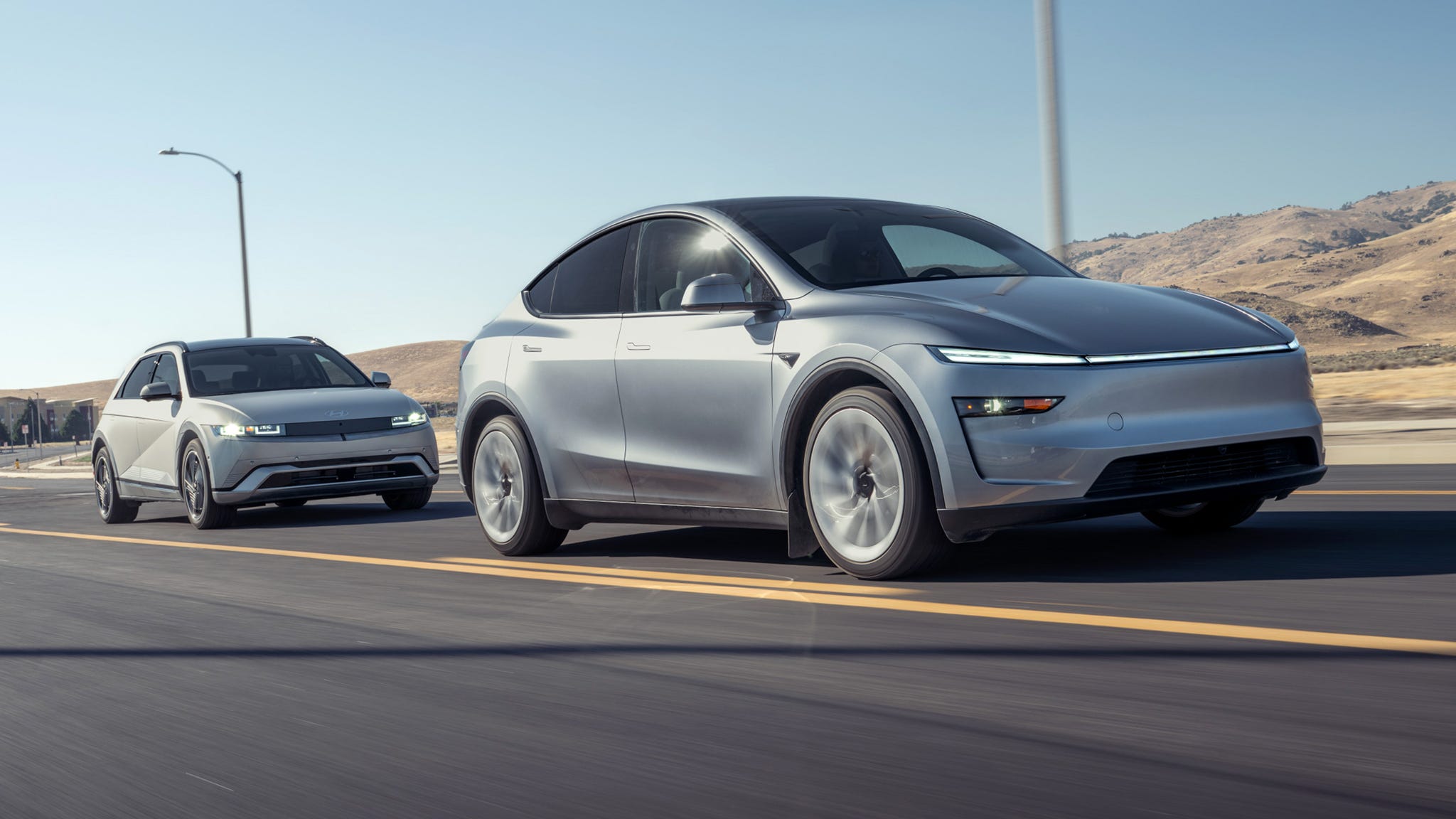
There’s no doubt both vehicles have improved. But which is more improved? Time to find out by comparing the Ioniq 5 against the Model Y once again.
State of Play
Following its arrival for 2023, Hyundai gave the Ioniq 5 a refresh for 2025. Telling it apart from its predecessor might be tricky—look for its reworked lower bumpers, new wheels, and rear windshield wiper.
Notable changes occur under the updated Ioniq 5’s skin, where larger batteries extend range, and all recharge via that ballyhooed NACS plug. Pricing for the 2025 Ioniq 5 starts at just more than $44,000, but our test vehicle for this comparison is a range-topping Limited AWD model, which rings in at $61,025.
On sale since 2019, the Model Y is now a familiar sight—but there’s no mistaking the Juniper’s LED light bars embedded in new bumpers and surrounded by several new body panels.
High-voltage battery and charging gear carries over, but the Model Y Juniper gets a bunch of new hardware, including the motor, suspension, steering, and braking systems. For now, the Model Y Juniper starts at slightly more than $46,000. Our Long Range AWD test example equipped with optional paint, wheels, interior, and Full Self-Driving software totals $63,630.
Getting Inside
Only Hyundai geeks would immediately spot all the changes inside the Ioniq 5. They build on a strong starting point to improve user-friendliness. The center console is reconfigured to put the wireless charging pad in closer reach, and some steering wheel toggles are larger. A closer look reveals a reversal of a new car trend: more real buttons than before.
Still, our drivers found some layout concerns. “The hard buttons are nice,” features editor Christian Seabaugh said, “but to change settings or interact with CarPlay I need to lean forward to hunt and peck away.”
Distant as the Ioniq 5’s touchscreen might be, for 2025 it runs a faster infotainment system. The presence of a driver’s display is notable and appreciated.
Opening the 2026 Model Y remains unduly tricky due to its flush, non-powered exterior door handles. Yet once inside, significant revisions make the Juniper seem almost like a totally new car. Beyond the general layout, nearly everything has changed: the reshaped steering wheel, ventilated front seats, improved speakers, color-changing ambient lighting, and power-folding back seats among them. Features editor Scott Evans highlighted the “obviously nicer and richer” materials used throughout. It’s a proper upgrade—and standard on every 2026 Model Y, not only top-spec ones.
Tesla’s techy approach persists. The drive-selector stalk is eliminated; now the car can automatically choose Drive or Reverse, and it chose correctly almost every time during our evaluations. While a big display remains the central control center, the new steering wheel gains buttons for common functions. Still, senior features editor Kristen Lee bemoaned the continued touchscreen dominance as “annoying, but that’s just how things are.” Somehow, there’s still no 360-degree view, despite the addition of another front-facing camera.
Overbearing as Tesla’s tech can be, there’s no denying the brilliance of its integration. The Model Y, mobile app, Supercharger network, navigation, service, and software updates all synchronize seamlessly. Mexico editor Miguel Cortina said, “I wish it had CarPlay, but Tesla’s infotainment offers so much that I don’t really miss it.” Hyundai’s road trip charge planning pales in comparison.
Our drivers still preferred to sit in the updated Ioniq 5, especially its spacious back seat; the Juniper’s new second-row touchscreen didn’t move the needle. Senior editor Aaron Gold speculated that “Perhaps Hyundai has an employee bonus program for good ideas that make it to production.”
Human-centric touches contrast starkly with the Tesla. In the Model Y, the rearview mirror is small, and the back glass is narrow. Meanwhile, the Ioniq 5’s rearview mirror and glass are sized in perfect correspondence. Despite Tesla’s efforts to improve the glass roof, light still excessively heats the interior; Lee called the Juniper’s continued lack of a sunshade ludicrous. The Ioniq 5’s split-opening sunshade makes a real difference.
So Different to Drive
In their previous matchup, track test performance for the Ioniq 5 and Model Y was close. Now the Juniper’s changes earn advantages in every performance metric. It smokes the Hyundai and its former self in a drag race, launching from a stop to 60 mph in 3.8 seconds—super quick for a mainstream vehicle.
Tesla also went deep to refine the overall driving experience. Success: The Juniper is clearly smoother and quieter than the original.
“It absorbs bumps and minimizes vibrations impressively compared to where it was,” Cortina said. Lee agreed: “It’s a more confidence-inspiring ride—no longer feels like it’ll be jolted off the road.” As great of an improvement as it is, the Juniper is still a Model Y. “It’s not totally comfortable,” Lee said, “but at least the suspension now feels appropriate for a 2026 vehicle.” Seabaugh noted a “constant pitter patter from all four tires.”
That firmness supports dynamics that give the Model Y a relatively sporty feel. Beyond how quick it is, its reactive steering and brakes provide an initially exciting impression. That sensitivity eventually becomes taxing, though. Gold opined that “the Tesla isn’t quite twitchy, but it overreacts. The steering ratio is too sharp; it gives a lot of lock with little effort.” In Sport mode the accelerator becomes touchy, and several drivers noted a tendency to understeer.
Even if the Ioniq 5 isn’t as zippy, it’s still enjoyable to drive with spirit: quick enough and showing relatively rear-biased handling. It retains good composure through bends, yet its willingness to change direction belies its long wheelbase. “I’m really impressed with the balance between ride and handling in this SUV,” Evans said. Buyer’s guide director Zach Gale called the isolation and quietness “almost like a luxury car.”
Others summed up the Hyundai’s driving manners with simple satisfaction: “quite nice,” and “very friendly,” and “just so pleasant.”
Still, there’s one thing the Tesla does better—slightly—than the Hyundai: a strong and effective one-pedal driving function. The Ioniq 5 offers on-the-fly regen adjustment, which can be useful, but we had to use its brake pedal a little more frequently than we did the Tesla’s.
Hands-Free Help
This new 2026 Model Y came with Full Self-Driving (FSD) active, bringing a much higher degree of driver assist capability than Tesla’s standard Autopilot suite and anything Hyundai—or any other automaker—offers. With that, the Juniper accelerated, braked, and steered itself through a variety of common road scenarios, usually quite adeptly.
Still, there’s no knowing when FSD will make a mistake. It struggled on a curvy, technical bit of our evaluation loop, driving rather slowly and crossing over the painted lane divider frequently. Then it repeatedly fumbled in the final stretch to the same destination on a consistent route, once looping through the parking lot several times, once parking halfway in the driveway, and once finishing in a lot across the street, which it drove to after going through the correct location.
The Ioniq 5’s driver aids work well, providing predictable assistance to hold the lane or gap to traffic ahead. Steering wheel buttons make adjustments easy, unlike the touchscreen-based Tesla. Its lane change assist can be timid, though. Still, when Tesla’s FSD has results like these, Hyundai’s relatively basic driver assist features seem more useful. They might not be cutting-edge capable, but at least they never literally steered us wrong.
Now: NACS
Electric innovation got Tesla to where it is, and its Supercharger network may yet play out to be a better business decision than its vehicles. As EVs switch to the previously Tesla-exclusive NACS charging port, their new access to Superchargers stands to further solidify the company as an industry titan and EV fuel provider in the long term.
Right here and now, though, it’s a game-changer for drivers—charging at Tesla stations is often so much less stressful and complicated than at other networks. It’s a truth only Tesla drivers have known until recently. Things might not always be easy as the Ioniq 5 and more keep pulling in, but Supercharger access changes the entire public charging strategy.
Today, though, the 2025 Ioniq 5 Supercharging experience is curtailed: It charges quicker using an adapter to the older interface common at Electrify America and EVgo, and not only by a little bit. That should eventually improve, but it will likely still be a quicker overall experience to use a Supercharger rather than waiting in line at some other public Level 3 plug. Or, if there’s no line, keep an adapter handy—point is, there are more options.
It’s something of a draw between the Model Y and Ioniq 5’s overall EV capabilities. Although the Tesla has a higher EPA range rating, it went only a bit farther in MotorTrend’s Road Trip Range test. However, it doesn’t charge quite as quickly as the Hyundai under ideal circumstances. Even so, the Tesla is more efficient.
For the sake of this comparison, the Ioniq 5 benefits greatly from gaining NACS. Beyond being a perk of its own, it lets the Hyundai’s other attributes shine. After all, “What good is a Supercharger station,” asked Gale of the Tesla, “if I’m exhausted when I get there and don’t wish to travel any farther?”
The 2026 Tesla Model Y in many ways remains a benchmark for how EVs should be designed and engineered. See the big frunk and sub-trunk, which the Ioniq 5 can’t match. What’s more, Tesla has made itself synonymous with EV lifestyle ideals through digital integration; the Model Y is so conveniently connected to various aspects of electric driving. “This level of technology is impressive, and no other car comes close,” Cortina said.
Still, even though the Model Y refresh is much more extensive than the 2025 Ioniq 5 update, too much of the original remains. “It’s clearly improved,” Evans said, “but it’s not a transformative difference.” Tesla may be one of the world’s biggest automakers, but in some ways it still thinks like a startup: Gale summed up the 2026 Model Y Juniper as “moments of brilliance punctuated by stupidity.”
Of the Ioniq 5, he said, “This is the 10-year car here—the one I could live with for a decade and not tire of its driving experience, interior, or design.” Gold called it “a great all-rounder that’s lost none of the charm that won it an SUV of the Year title.” As before, the Ioniq 5 comes together as an electric crossover we actually want instead of the one that just makes the most sense. With NACS now on board, it makes a lot more sense—more than the Model Y, in fact.