[This story originally appeared in the June 2006 issue of MotorTrend.] There are probably few things in the world more pointless than a 190-mph convertible. Even if you could find somewhere to go 190 mph, driving one with the roof down at that speed would be like sticking your head in the dyno room at General Electric while the boys are bench testing an F/A-18 jet engine. On full afterburner.
Convertibles, of course, are for being seen in, mobile fashion statements that usually do their best work nailing the primo parking spot on the forecourt of the nearest Ritz-Carlton. But mooching around Beverly Hills or South Beach strapped into a convertible with $15,364 worth of race-tuned carbon-ceramic brakes underfoot, or 513 horsepower of autobahn-hungry V-10 growling quietly at your shoulder blades, seems, ahhh, a slight waste of engineering.
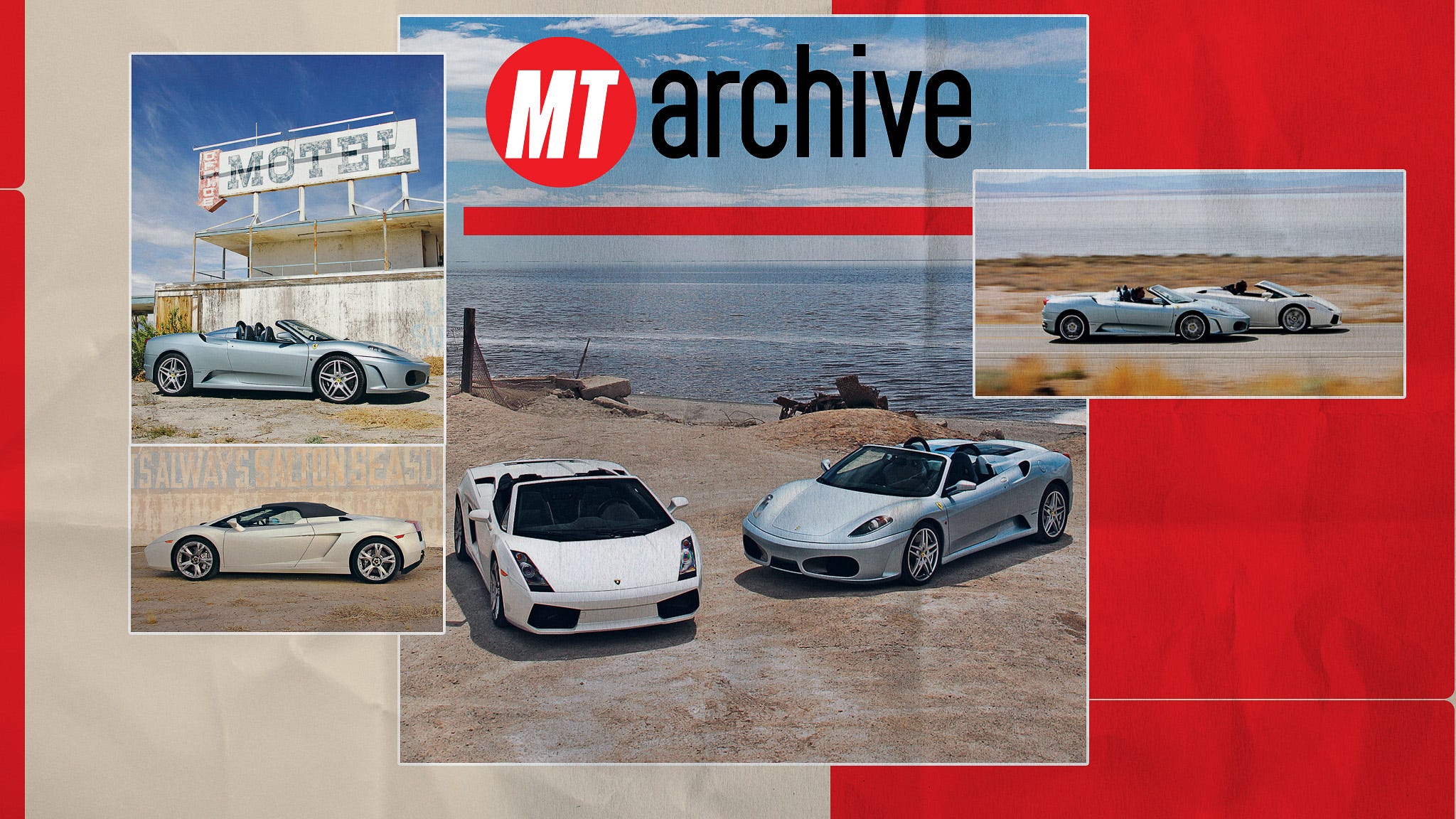
Yes, you could argue Ferrari’s F430 Spider and Lamborghini’s new Gallardo Spyder (the spellings are correct: Ferrari takes the “i” road, while Lamborghini takes the “y” road) are indeed pointless cars. So we’re not going to dwell on the fact they don’t have much luggage space. We won’t mention that their gas mileage struggles to get into double figures, nor discuss whether the Lamborghini is a better value than the Ferrari. Nope, we’re just gonna get in and drive them. Hard. Because if you do have the means to mooch around in a convertible supercar, it’s nice to know that you’re not just doing it because it makes you look cool. No, really.
Both these cars have been covered in detail in previous issues (Ferrari, September 2005; Lamborghini, March 2006), so you know the basics: 4.3-liter, 483-horsepower V-8 driving through the rear wheels plays 5.0-liter, 513-horsepower V-10 with all-wheel drive. Removing the roof has added a little weight (about 150 pounds for the Ferrari, and 260 for the Lamborghini) and cost a little rigidity. As tested—with those carbon-ceramic brakes and $5004 worth of sports seats—our F430 stickered at $229,590, while the sat-nav and E-gear equipped Gallardo weighed in at $216,000.
All chiseled panels and edgy attitude, the Gallardo threatens to steal the show even before you reach for the door handle. Although not as good-looking as the coupe, it’s still a 21st-century supercar, not a digitally remastered refugee from the 1960s. The pert soft-top curls tightly over the cabin and folds away neatly under the rear engine cover with the push of a button, leaving that steeply raked windshield to exaggerate its charging-bull stance.
The tight, taut Gallardo is tiny—it’s shorter than a 911—and makes the F430 look surprisingly big and blowsy by comparison. Imagine Kate Moss standing next to a hungover J-Lo, and you’ll get the picture. Evolutionary rather than revolutionary, the F430 Spider isn’t the most beautiful of Ferraris, its generously curved surfaces bisected by random creases that simply give up and go nowhere in places, and panel gaps visible from Mars.
Removing the roof has given the F430 a slightly hunchbacked stance and accentuated the hips over the rear wheels—but not in a good way. And the attempted reincarnation of the famed shark-nose from Ferrari’s early 1960s Grand Prix cars makes the front end look oddly anonymous. But the sight of the mid-mounted V-8 engine lurking under a glass panel behind the cockpit (even if you open the carbon-fiber engine cover, the Gallardo’s V-10 lies hidden under the tray where the soft-top stows) shows Ferrari hasn’t entirely forgotten how to do supercar showbiz.
Inside, at least, the F430 looks strictly business. The instrument panel is dominated by a giant tach, and the steering wheel features a big red starter button and a civilian version of the manettino Michael Schumacher uses to adjust the settings of his race car. Yeah, there’s leather on the seats (optional carbon-fiber sport buckets in our tester) and the other surfaces, and there’s air con, a sound system, and even a rudimentary nav system. But you get the feeling Ferrari just puts that stuff there because that’s what you’re supposed to have in a $200,000 car these days.
The Gallardo’s cabin is bijou-limo by contrast, and not just because of all the nice instruments, switches, and other cabin hardware appropriated from the Audi parts bin, including the versatile MMI system. Flawlessly stitched leather, lots of glossy carbon fiber, and superb detailing make the Gallardo’s interior a luxurious place to be, although the car’s compact exterior dimensions means it’s a much tighter fit than the Ferrari, especially if you’re over six feet tall. And while Lamborghini might be owned by VW Group these days, the Audi cabin light unit that kept falling out of its slot in the rear bulkhead shows the Germans still haven’t fully subjugated the Sant’Agata workforce.
Twist the key, the Lamborghini’s V-10 spools up like a turbine before exploding into a sonorous idle. Our tester came with the optional E-gear paddle-shift manual transmission: foot on brake, pull the right-hand paddle back toward the steering, ease off the brake, and squeeze the gas. The Gallardo hesitates momentarily as the clutch feeds itself in, and then you’re away. The transmission has four modes: Normal, Sport, Automatic, and Snow. Automatic mode means you let the transmission computer pick the ratios; Sport mode sharpens shift times, and in Automatic mode also holds each gear an extra 500 rpm. We select straight Sport mode. And nail the gas.
The Gallardo hooks up all four wheels and just goes. As the tach needle swings past 2800 rpm (3400 if you’re not absolutely right on it), the exhaust bypass valve opens, and the big V-10 bellows as if it’s suddenly been switched through a stack of Marshall amps. Turned to 11. The redline is 8100 rpm, but you’d better start fanning that right-side paddle the instant you see the needle swing by 7600, otherwise the engine smacks the rev-limiter so hard you’ll damn near head-butt the steering wheel. Get it right, though, and you’ll hit 60 mph in just 3.8 seconds, 100 mph in 9.0, and storm through the quarter mile in 12.1 seconds at 116.3 mph.
From the very first corner, the Gallardo feels, well, German: solid, measured, and utterly convincing. Left foot hard on the brakes, click the left-side paddle, and the engine gulps a great lungful of air before grunting out a monstrous yelp as the tranny selects the next ratio down. The Gallardo dives for the apex the moment you pull the steering wheel off center and grips like a limpet as you carve through the middle section of the turn on a neutral throttle. As with most all-wheel-drive cars, it pays to wait a bit until you nail the gas hard again, but when you do you can feel the front wheels helping to pull you out as the Gallardo catapults to the next corner. It’s awesomely good, easily the best-handling Lambo in history.
But you only need a half mile in the Ferrari to realize the F430 is the driver’s car of this pair. From the moment you get underway, it instantly feels more agile, more eager, more responsive than the Lamborghini. That’s partly because the Gallardo weighs 362 pounds more than the F430, but also because of the Germanic heft of the controls. You steer the F430 with your fingertips, but the Gallardo with your shoulders.
The Ferrari’s V-8 is a screamer, zinging around to its 8500-rpm redline with a shattering calico-rip of sound as the exhaust bypass valves snap open. The F1 paddle-shift transmission is easily the best in the business, so sensitive and responsive you swear there’s a mechanical linkage between your fingertips and the six ratios out back. Ferrari’s greater experience with paddle-shifters also shows in the smoother clutch takeup and more adjustability within the transmission modes: The Gallardo leaves you wondering, but after the F430’s F1 tranny, you’ll never want a stick shift again.
The manettino control on the F430’s steering wheel allows five different performance modes: Ice, Low Grip, Sport, Race, and no-traction-control CST. Switch from Sport to Race, and the suspension firms up and the shifts quicken noticeably. What’s impressive is that even in Race mode the F430 rides better than the Lamborghini, its lighter weight, longer wheelbase, and what appear to be softer spring rates enabling it to dance across lumps and bumps in the road. And by just feathering the gas as you fan the right paddle, the Race mode shifts are the quickest and smoothest you’ll ever experience in a manual car around town.
Ferrari doesn’t offer launch control on U.S.-spec F430s (they must think we’re soft), but our Italian-spec tester had it. And using that mode, along with the little-known cheat code built into the transmission software (see MT, June 2005), we were able to nail 60 mph in 3.8 seconds, 100 mph in 8.6 seconds, and the standing quarter in 12.0 seconds at 120.7 mph. This technique, which involves zinging the engine and simultaneously stepping off the brake at 4700 rpm (the computer then allows the clutch to slip instead of the tires to maximize drive, like a Top Fuel dragster), isn’t officially approved by Ferrari because if you get it wrong (you don’t gradually bring the engine revs up; it all has to be done in one fluid, rapid sequence), that expensive clutch is toast. So for us, those numbers are academic.
This is the third F430 we’ve tested, and we’ve found the basic CST-mode launch results in times about two- to three-tenths slower across the board. And even with the trick launch sequence, the Ferrari can’t match the astonishing grip of the all-wheel-drive Gallardo off the line (at 1.2 seconds, the Lamborghini is a whole two-tenths of a second quicker to 30 mph), though by the time it’s hooked up, the prancing horse starts reeling in the raging bull, building speed more rapidly through the gears.
Throw the F430 some corners, however, and the sublime steering, better gearing, firmer brake pedal, and more responsive engine (the Gallardo’s V-10 seems to build thrust in a curiously languid manner that has you wondering whether there really are 513 ponies corralled out back) lift it into another league. The Ferrari rewards precision, yet remains supremely adjustable: On the test track, it sliced through the slalom nearly two mph faster than the Lamborghini, test shoe Neil Chirico gently teasing the tail out through the cones. The Gallardo initially feels more relaxed than the F430, but it’s only when you switch between the two that you suddenly realize how much more physical effort you put into driving it.
To be honest, we’d rather have the coupe versions of either of these cars. But if we had to choose one, it would be the Ferrari. Yes, the looks are a bit disappointing, and the build quality not as good as that of the Gallardo. But it’s the most inspiring of the two to drive. You feel hardwired into the Ferrari’s central nervous system, totally aware of every man-machine interaction and reaction, and totally in command.
At least that’s what you can tell the valet parking guy.