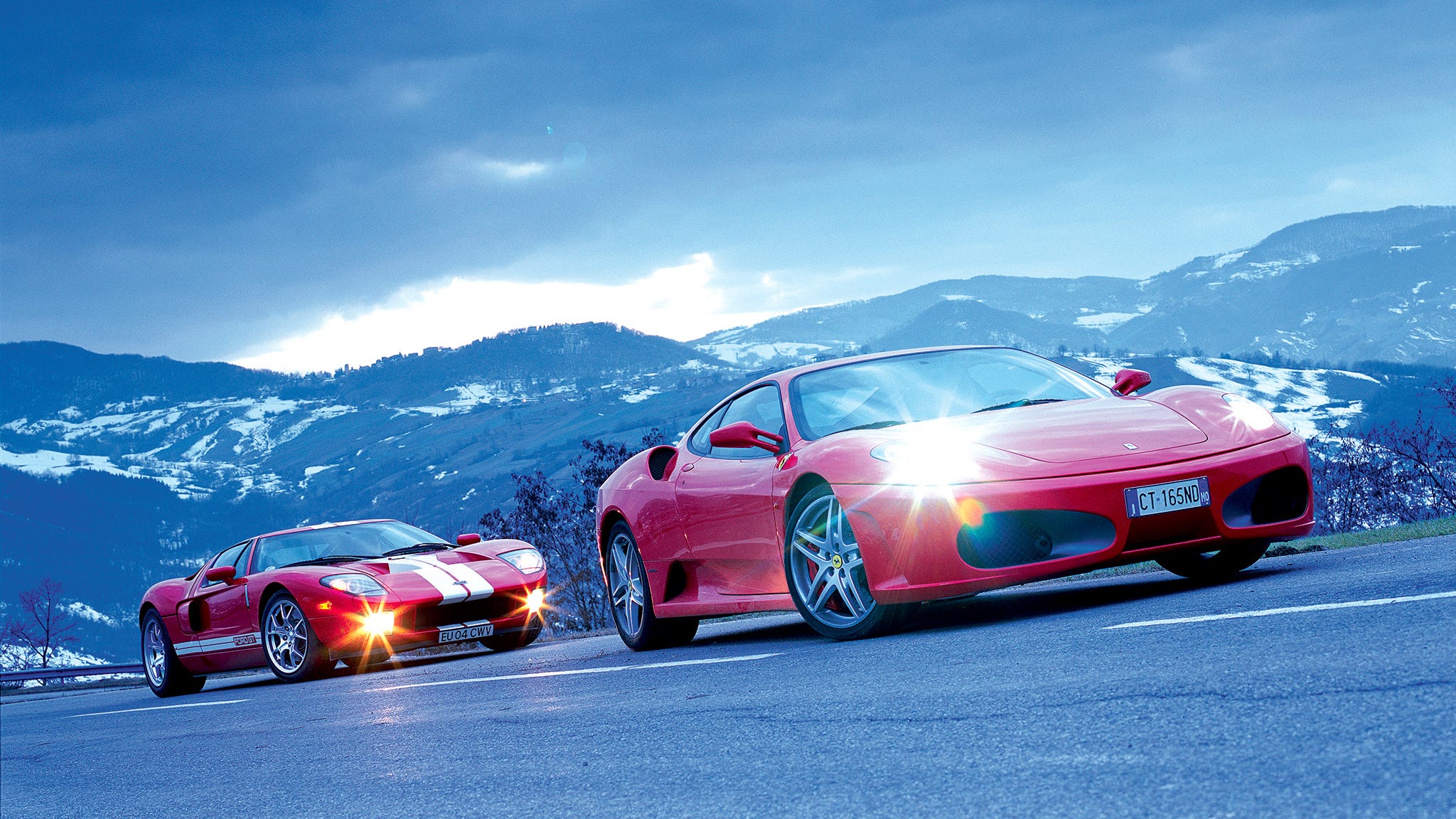
[Editor’s Note: This story first appeared in the June 2005 issue of MotorTrend] It’s hard to imagine a Ferrari feeling its best in south Michigan–the endless straight roads, slapping concrete surfaces, and potholes the size of a Kenworth; the speed limits, the traffic, the stoplights. It’s definitely not Ferrari country. That’s why we’ve brought the Italian’s Detroit rival, the Ford GT, to the heart of Ferrari territory, up in the mountain back roads above Maranello, the very twisting routes where Ferrari tests Ferraris.
And the Ford is loving it. It grabs these hillsides by the throat, dispensing its 550 horsepower onto the pavement with an urge that stuns. It rockets out of the hairpins, second gear throwing us back into the seat, widening our eyes. That one cog will blast to 90 mph when there’s the chance, and when we reach the top of the hills it gets it, the bright red GT flashing along ridgetop roads like a low-flying jet.

Today we’re moving in formation. Shadowing the GT’s every move is Ferrari’s latest V-8 coupe, the F430. Two red flashes, vivid as slashes in your retina. The Ford impossibly low and wide, an organically primal shape, that flat rear deck offsetting the swollen rear fenders in a shape so hormonally suggestive it ought to be banned from daytime TV. How can any car make a Ferrari look so narrow, pinched, and tall? That’s not to say there’s no interest in the Ferrari shape: The way it handles air in/out ducting is beautifully worked, and the scarcity and narrowness of its cutlines make it seem a higher-quality piece than the Ford.

Both use rear glass to make display cases for their engines. At 4.3 liters versus 5.4, the Ferrari is down on capacity on the GT and down by a supercharger, too. Crucially, the F430 is also down on weight. And, as we’re finding through these enchantingly challenging roads, the local opens up a gap on the visitor. We swap between the cars, and the Ferrari pulls out in front, steadily making distance–at least until the road goes straight, when the Ford winches the Ferrari back in. This is a fascinating contest; a series of drives that will sear their way into our memories.
So how does the Ferrari find this twisty-road speed? Not through extra grip, oddly. Broaching the limits in this car is not, to be honest, a job for the likes of me. What this car does brilliantly is signal the outer edge and hardwire itself into your nerve endings, bringing magic to the fingertips. The faster the corner, the more this intimacy comes into play.
One secret, and its great advance over the 360 Modena, is the E-Diff, an electronically controlled variable-locking differential. As it locks, it inclines the car to go straight, increasing traction, understeer, and steering weight. It’s mapped to open itself on corner entry then lock on exit, and the degree of its actions can be selected via the five-position rotary switch on the steering wheel. Step by step, this car can grow from a conservative machine, with understeer and eager ESP intervention, to an edgier dry-roads animal where the ESP threshold stays far, far out.

The GT has colossal traction and requires a different driving style. Where the Ferrari dives flat and instant into a corner like a racer, the Ford’s steering is nowhere near as eager, and there’s a remote, viscous quality to the system that holds you at arm’s length. This isn’t an endearing quality in a supercar this fast. But once into the corner, squeeze on that mighty supercharged V-8 and feel the outer rear tire load up. Balance the load and listen to the car via its rear–whereas the Ferrari needs to be driven via its nose. Even without the full electronic safety net Ferrari provides, you and the GT are soon comfortable together, and, in short order, truly rocking.
One real surprise, given that these are Ferrari’s roads, is how at ease the Ford is over the bumps. The surfaces are buckled and corrugated. The Ferrari–even if you set its dampers soft by winding back the electronics–is always harsh and edgy in its ride. The Ford has excellent damping control, but manages to breathe much more deeply, moving fluently over the surface, avoiding getting knocked off course. And at all speeds, it’s far more comfortable. On better highways, this manifests itself as a more relaxed gait that helps the GT change footwear from running spikes to seven-league boots. That complements the engine. Wafting in sixth, you can do fast autostrada speeds, while barely dipping your toe into the Ford V-8’s deep waters.